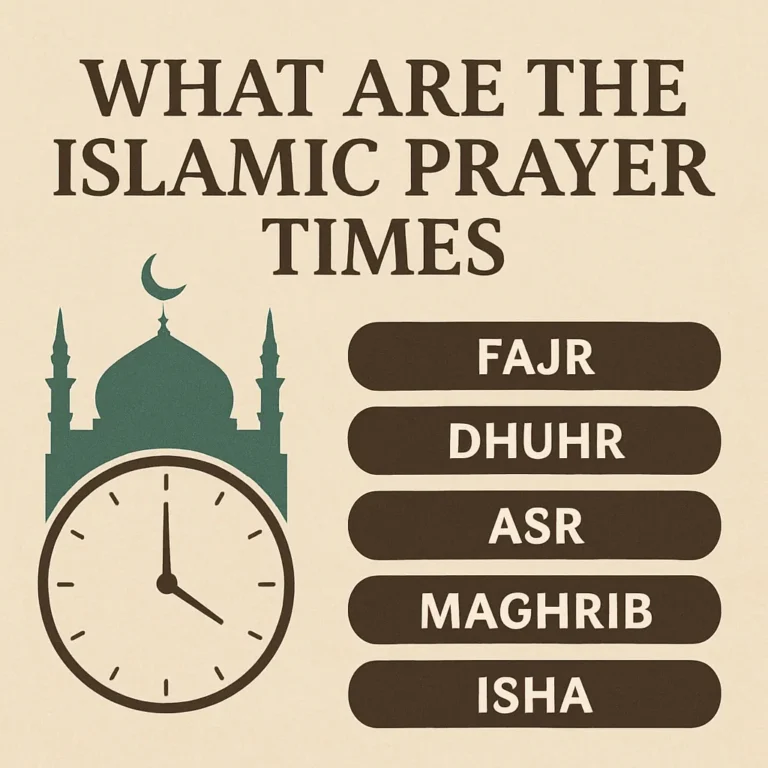
What are the Islamic prayer times? This is a question that many Muslims and curious readers ask as they seek to understand how daily worship is organized in Islam. In practice, the phrase refers to a structured set of times throughout the day when Muslims perform the Salat (often called Salah in the Arabic-speaking world and Namaz in some communities). This extensive guide explains the Islamic prayer times, how they are determined, how different communities calculate them, and how to apply this knowledge in everyday life. Whether you are new to the faith, a student of religious studies, or someone planning travel or a move to a new city, you will find practical, accurate, and actionable information here.
Understanding the Five Daily Prayers and Their Timings
In Islam, the daily prayer routine consists of five obligatory prayers spread across the day. The exact times shift with the seasons and your location, but the order and the basic concepts remain the same. The five prayers are Fajr, Dhuhr, Asr, Maghrib, and Isha.
Fajr: The pre-dawn prayer
What it is: The first of the daily prayers, performed before sunrise.
General timing: Begins at the onset of true dawn (the first light in the sky) and ends at sunrise.
Practical note: In many communities, Fajr is the time when Muslims wake for morning prayers and begin the day with reflection and supplication.
Dhuhr: The early noon prayer
What it is: The second of the five prayers, performed after the sun has passed its zenith.
General timing: Begins sometime after solar noon (when the sun is highest in the sky) and continues until the afternoon.
Practical note: Dhuhr often coincides with the midday break in work or school in many Muslim-majority regions.
Asr: The afternoon prayer
What it is: The third daily prayer, offered in the afternoon.
General timing: Begins after Dhuhr and ends before Maghrib, with two common scholarly opinions about its exact start in relation to the length of an object’s shadow.
Practical note: The timing of Asr can vary depending on the Islamic legal school (madhab) one follows, particularly regarding shadow length rules.
Maghrib: The sunset prayer
What it is: The fourth prayer, performed just after sunset.
General timing: Begins immediately at sunset and lasts only a short period before the Isha time begins.
Practical note: In many communities, Maghrib is associated with breaking the fast during Ramadan, when applicable, though its validity is not tied to fasting itself.
Isha: The night prayer
What it is: The fifth and final obligatory prayer of the day.
General timing: Begins after astronomical twilight has ended (when the night becomes fully dark) and lasts through the late evening.
Practical note: Isha time can be affected by local practice, with some communities using a fixed interval after Maghrib, others using a fixed angle for the night’s darkness.
These five prayers together frame a daily rhythm of worship that helps believers orient their day around spiritual reminders, gratitude, and supplication. The exact times shift based on location and season, but the structure remains consistent: dawn, solar noon, mid-late afternoon, sunset, and night.
How Prayer Times Are Calculated: The Astronomical Foundations
To answer the question “what are the Islamic prayer times” in a precise way, it helps to understand the astronomical concepts behind the timings. The daily prayer schedule largely depends on the position of the sun relative to the observer on the Earth. The key concepts include:
Solar noon: The moment when the sun reaches its highest point in the sky for that day. This is typically when Dhuhr begins.
Sunset: The moment when the sun crosses the western horizon. This is when Maghrib begins.
Twilight and dawn: The periods of dawn before sunrise and twilight after sunset that determine the start of Fajr and Isha. Different calculation methods measure twilight by the sun’s depression below the horizon (degrees) or by fixed clock rules.
Dawn types and prayer definitions: In many calculation systems, Fajr starts at the onset of true dawn (astronomical twilight) and Isha begins after nightfall is complete (astronomical night), though some communities use slightly different definitions.
Twilight-based methods are the most common in modern practice. They define the start of Fajr and the end of Isha by the sun’s angle below the horizon. For example, a typical reference angle for Fajr might be 18 degrees below the horizon in one widely used system, while Isha may be defined at 17 degrees below the horizon. Different regions and organizations adopt different angle values, which is why you will often see variations in prayer times when comparing two reliable sources for the same location.
In addition to angles, some communities use fixed time intervals after sunset or after solar noon, especially in places where the angle-based methods are difficult to apply due to unique geographical features or practical considerations. This combination of approaches can be described as regional standards and calculation methods, each reflecting a balance between traditional practices and modern astronomical calculations.
Calculation Methods and Their Variations: A Practical Guide to Understanding Differences
What are the Islamic prayer times? The short answer is: they depend on your local method. Across the Muslim world, several widely used calculation approaches are in common use. Here are the major categories and some representative examples to help you understand what you might encounter in mosques, apps, or websites.
Angle-based methods (twilight-based)
Fajr angle: The angle below the horizon at which Fajr begins. A typical value is 18 degrees, but some communities use 15 or 19.5 degrees depending on tradition and local practice.
Isha angle: The angle below the horizon at which Isha begins. Values commonly range from 14 to 18 degrees, with 17 or 18 being common in several widely used systems.
Purpose: These methods aim to reflect the true psychological and astronomical dawn and night characteristics in a way that aligns with the practice of prayer, particularly in winter and summer when daylight hours vary dramatically.
Fixed times after sunset or solar noon
Fixed Isha or Fixed Maghrib times: Some communities or apps offer Isha as a fixed duration after Maghrib (for example, 60 or 90 minutes) or Maghrib as a fixed duration after sunset, to simplify schedules in areas with extreme daylight swings.
Fixed Dhuhr and Asr windows: In certain traditional practices, the start of Dhuhr and Asr can be delineated by fixed segments of the day, particularly for schools or workplaces that need rigid timetables.
Regional standards and well-known conventions
MWL (Muslim World League): A widely used method that uses specific sun depression angles to determine Fajr and Isha; it is implemented in many global prayer-timing apps and websites.
ISNA (Islamic Society of North America): Another common method, often used in North America, with its own conventional angles for Fajr and Isha to accommodate local practice.
Umm al-Qura (Makkah) style: Used in Saudi Arabia and certain regions, frequently adjusted to reflect contemporary practice in large urban centers; sometimes it incorporates time-based rules for Isha and Maghrib.
Egyptian General Authority and Karachi/Other regional authorities: These authorities provide official timetables for their areas and sometimes publish multiple options to accommodate different communities.
Because prayer times vary by location and because the chosen calculation method affects the result, it is essential to consult a reliable local source. Always check with your local mosque or a trusted app that allows you to select your preferred method to ensure accuracy for your address.
Practical Guidance: How to Find Your Local Prayer Times
Now that you understand the theory, here’s a practical, step-by-step guide to finding reliable prayer times for your location. This guidance helps answer the question, “how do I know the exact times for prayers where I live?”.
Identify your location precisely: Use your city, neighborhood, and, if possible, your coordinates. Small changes in location can shift times by minutes or more, especially at high latitudes.
Choose a credible calculation method: Pick one of the common standards such as MWL, ISNA, Umm al-Qura, or Egyptian. Many apps invite you to choose your preferred method; select the one that matches your community’s practice.
Use a trusted source: Mosque timetables, official local authorities, or reputable apps provide the most up-to-date times. Check the source’s notes about any daylight saving time adjustments or city-specific rules.
Confirm changes with your mosque or community center: If you are traveling, moving, or joining a different community, confirm which method they use to align your practice with local norms.
Consider seasonal adjustments: In extreme latitudes, prayer times can vary dramatically between seasons. If you live at high latitudes, you may encounter days with very short or very long windows for certain prayers; plan accordingly.
Practical tools to help you include:
Smartphone apps that provide customizable calculation methods and automatic location detection.
Online calculators keyed to your city or neighborhood.
Printable timetables published by local mosques, especially helpful for families planning meals and school routines.
Alarms and reminders that alert you a few minutes before the prayer time begins, enabling you to prepare properly for ruku and sujud.
Practical Considerations: Observing Prayer Times in Daily Life
Understanding the concept of what are the Islamic prayer times becomes especially important in the context of daily routines, travel, work, and school. Here are practical tips to integrate prayer times into everyday life while respecting local norms and personal circumstances.
At work or school: Arrange a brief break around Dhuhr or Asr to perform prayers with minimal disruption. If a mosque is accessible, you may be able to pray there during lunch or a scheduled break.
Traveling: When crossing time zones or moving through long distances, keep a reliable source for your destination’s times. If you cannot reach your usual place of worship, you can pray according to the nearest mosque or use the local times of your current location if you’re staying for a finite period.
Ramadan considerations: During Ramadan, the daily fasts hinge on the exact Maghrib time. Being precise with Maghrib is essential for breaking the fast at the correct moment.
High-latitude challenges: In some northern or southern places, the sun may not set or rise for extended periods. In such cases, communities follow specific local rulings or endure the corresponding, agreed-upon timetable issued by scholars or local authorities.
Asking the Right Questions: Common Scenarios and How to Respond
People often ask, “What if my city uses a different calculation method from my home country?” or “What should I do if I cannot find the precise method I prefer?” Here are clear answers to frequent scenarios, with practical steps you can take.
Scenario: I joined a new community with a different method
Ask your new community or mosque which calculation method they follow and request their timetable.
Align your personal practice accordingly to avoid confusion during communal prayers, especially for times when the start of a prayer halos across the fence between methods.
Use a personal reminder that allows you to switch between methods if necessary when you travel, so you can maintain consistency with the local practice during your stay.
Scenario: I am traveling across time zones
Rely on your current location’s times for the duration of your stay at that place, then adjust to the new location when you arrive.
Use location-based apps that automatically update times as you move; this minimizes the risk of praying at the wrong time due to jet lag or schedule changes.
Consult reputable online timetables or apps that offer location-based times for your city and the surrounding area.
In urgent situations, you may perform the prayers based on the local time and the best available reliable calculation method, then align with your community upon returning.
Common Mistakes to Avoid and Best Practices to Adopt
Even seasoned Muslims can encounter certain pitfalls if they are not careful with their timing. Here are common mistakes and how to avoid them, followed by best-practice recommendations to ensure accuracy and continuity in daily worship.
Confusing dawn with false dawn: Some readers confuse the early light at dawn with the moment when Fajr begins. Remember that Fajr starts at true dawn (astronomical twilight), not merely when the sky becomes light.
Ignoring high-latitude variations: In some places, winter days have very short daylight windows for Fajr and Dhuhr, and in extreme cases, times can shift rapidly. Use a reliable method approved by your local community to navigate these changes.
Assuming a single timetable fits everywhere: Times vary by location, season, and method. Do not rely on a timetable from another city without verifying its applicability to your area.
Not updating for daylight saving time: Some regions observe daylight saving, and others do not. Ensure your source reflects the correct local time offset.
Not accounting for travel adjustments: When traveling, agree on whether to follow your home method or the local method of the place you are visiting. Both approaches are used in practice, depending on community norms and personal preference.
Frequently Asked Questions: Quick Clarifications
Below are concise answers to common questions about the topic. If you need deeper explanation, you can read the full context above.
What are the Islamic prayer times?
Answer: They are the five daily times when Muslims perform the obligatory prayers—Fajr, Dhuhr, Asr, Maghrib, and Isha—as determined by the position of the sun and the chosen calculation method for a given location.
Why do prayer times vary by location and method?
Answer: Because the sun’s position differs by geography, and because different communities use different definitions of twilight or different intervals after sunset. This leads to a range of acceptable times across regions, which is why local timetables reflect community norms.
How should I handle prayer times while traveling?
Answer: Prefer the local timetable of your current destination, or follow a method your home community recognizes, provided you maintain consistency. Always verify with a local mosque if you have any doubt.
What should I do in extreme daylight situations?
Answer: In places with unusual daylight patterns (e.g., far north or far south), communities often follow a scholarly local ruling that prescribes a practical approach. In such cases, consult your mosque or a trusted scholarly source for guidance.
Conclusion: A Practical Summary for Everyday Life
In summary, the Islamic prayer times are a structured timetable designed to anchor a Muslim’s day around worship and remembrance of God. The times are determined chiefly by the sun’s position and are interpreted through one of several widely used calculation methods. The key concept to hold is that there are five daily prayers, each with its own distinct window, and the exact moments of those windows shift with latitude, season, and the chosen methodology.
For most readers, the practical path is clear: determine your local time for each prayer using a reliable source, select a calculation method that corresponds to your community’s practice, and keep that method consistent. With the aid of modern technology—apps, online timetables, and mosque calendars—you can observe accurate prayer times with ease, even while traveling or living abroad. By embracing this practical guide to the question “what are the Islamic prayer times?”, you can synchronize your daily routines with spiritual discipline in a way that is both convenient and faithful to tradition.
Remember, the ultimate purpose behind knowing Salat timings is not simply to memorize minutes and seconds, but to cultivate regular moments of connection, gratitude, and humility throughout your day. The exact numbers matter less than the consistency, sincerity, and intention with which you approach each prayer.