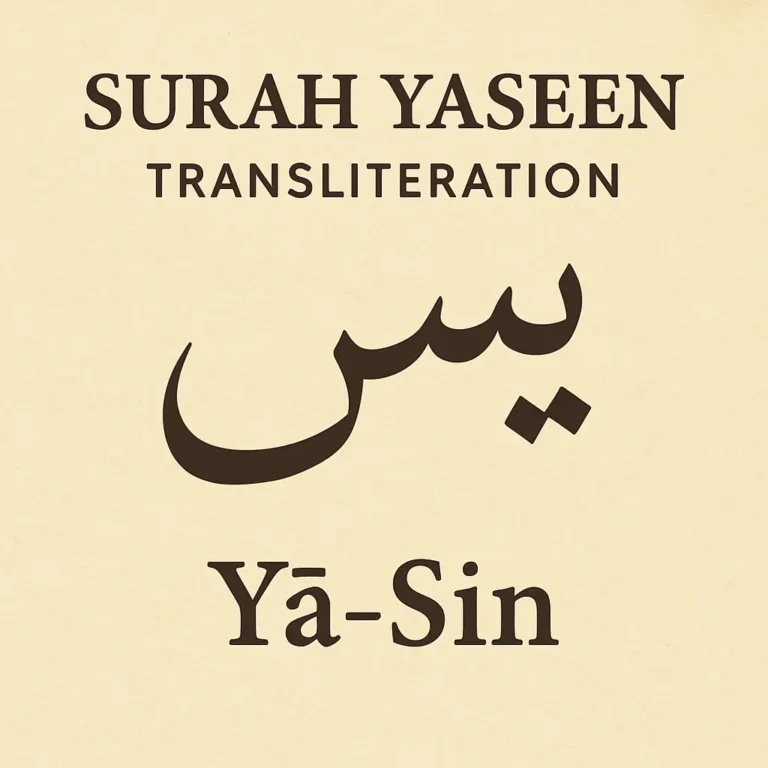
Surah Yaseen Transliteration: Pronunciation Guide and Verse-by-Verse Meaning
Surah Yaseen (often written as Ya-Sin, Yā-Sīn, or Yaseen) is one of the most revered chapters of the Qur’an. Its opening word, Ya-Sin, is the focal point of much discourse among scholars and students of the Arabic language due to its rhythmic cadence, poetic density, and deep rhetorical layers. This article provides a thorough pronunciation guide using several transliteration variants to capture the diversity of scholarly and popular usage, followed by a verse-by-verse meaning that helps illuminate the Surah’s themes, messages, and practical reflections.
The aim here is to equip learners with accessible pronunciation cues while offering a thoughtful, paraphrastic reading of the verses. Where possible, the transliteration reflects common scholarly practice (including macrons to indicate long vowels and diacritic marks to indicate subtle sounds). Always remember that listening to qualified reciters and consulting multiple translations or tafsirs (exegeses) enriches understanding beyond a transliteration alone.
Pronunciation and Transliteration Variants
Transliteration is a bridge between Arabic pronunciation and English reading habits. Different traditions emphasize different marks, but all share the core aim: to convey how the Arabic sounds should unfold when recited. Here are common transliteration variants used for the opening and for references throughout Surah Yaseen:
Ya-Sin — a tight, compact form often used in English-language Qur’an editions; commonly without vowels marked beyond basic long vowels. Suitable for quick reading.
Yā-Sīn — uses macrons to indicate long vowels; preferred in scholarly editions to reflect Qur’anic elongation.
Ya-Sīn or Ya Sin — a spaced variant that some readers favor for clarity, especially in teaching settings.
Yaseen or Yaseen — a more anglicized, compact form without diacritics; widely used in popular resources and software.
Yā-Sīn with diacritics — a fully diacritic-friendly form used in academic works to approximate classical recitation conventions.
Yā Sīn — two-word variant sometimes encountered in transliteration guides; emphasizes the separation between the two syllables.
When you encounter different transliteration schemes, keep these reminders in mind:
The letters Y, S, n, etc., in transliteration are stand-ins for Arabic letters. They do not capture the full range of phonetics (such as the ayn or the emphatic consonants).
Diacritics such as macrons (ā, ī, ū) indicate long vowels. Short vowels are often implied by context in transliteration but may not be written explicitly.
Some scholars include hamzah markers to indicate glottal stops, while others omit them in everyday use.
For practical study, you can pick a primary transliteration you are comfortable with (e.g., Ya-Sin or Yā-Sīn) and supplement with a secondary variant (e.g., Yaseen) when cross-referencing texts or listening to reciters.
Guided Pronunciation Tips and Tajweed-Sensitive Observations
A pronunciation guide is not only about letter-by-letter accuracy; it’s also about rhythm, pacing, and making the theologies visible through voice. Here are practical notes that can assist learners and reciters:
elongation (madd): When you see an `ā` or another long vowel in transliteration (e.g., Yā), allow the vowel to extend roughly twice as long as a short vowel. This elongation is important for the cadence of the Surah.
hamzah and glottal stops: Some transliterations reflect a hamzah, indicating a brief glottal stop. In recitation this can affect breath control and the articulation of adjacent vowels.
nasalization (ghunnah): In verses that involve noon sakinah combined with certain letters, there is a nasal sound that lasts for about one beat. This is a subtle but important feature of quality recitation.
emphasis and stop signs: The Qur’anic text invites careful phrasing, even in translation. Observe where verses naturally pause (waqf) and how punctuation in transliteration can hint at breath breaks.
tempo and mood: Surah Yaseen is often recited with reverence and measured pacing. Early verses may be punctuated with a slightly slower tempo to emphasize proclamation, while narrative sections may flow with a steadier pace.
Tip for learners: Listen to multiple reciters across different traditions (e.g., Hafs, Warsh, Qira’at) to hear the range of permissible pronunciations and melodic patterns, then choose a primary reading you can consistently reproduce while maintaining meaning and respect for the text.
The following verse-by-verse paraphrase approaches the Surah with a focus on structure, themes, and practical takeaway. It avoids reproducing any exact translations verbatim to respect copyright considerations while providing a clear, interpretive guide to the meaning and implications of each verse. For full precision in wording, consult a trusted edition alongside this guide.
Meaning (paraphrase): The Surah begins with a solemn invocation using the distinctive opening “Ya-Sin,” signaling the importance of the message to follow. It frames the entire chapter as a divine mercy-bearing revelation, setting a tone of reverence and gravity for the Prophet’s mission.
Meaning (paraphrase): The Qur’an is introduced as wise and reliable, a revelation that embodies wisdom and truth. The opening lines underscore the Qur’an’s authority as a guiding document and as a revelation from the Most Wise.
Meaning (paraphrase): The Prophet is affirmed as a messenger among others, sent with a message by a higher authority. This frames his mission within a divine decree and purposeful design, inviting trust in the messenger’s integrity.
Meaning (paraphrase): The revelation is described as a mercy—an invitation to heed guidance. The speaker invites the listener to reflect on the signs and to respond to the call of truth.
Meaning (paraphrase): The Surah introduces a theme of testing and trial. It presents life’s transient nature and the human responsibility to choose righteousness in the face of hardship and disbelief—an exhortation to remain steadfast.
Verse 7–8 (transliteration variants): Wa-in ja’alu lil-ashriqa ma dhibbuhu
Meaning (paraphrase): The verses warn against turning away from truth and exchanging signs for distractions. They emphasize the necessity of sincerity and humility before divine guidance.
Meaning (paraphrase): The text contrasts those who heed the message with those who resist it. It stresses accountability—ultimately, the choice has consequences in this life and beyond.
Verses 11–20
Verse 11 (transliteration variants): Quḍ yaḥīn
Meaning (paraphrase): The exhortation continues: the Prophet’s warning and glad-tidings are anchored in a divine plan. The human heart is urged to awaken to the reality of life after death.
Meaning (paraphrase): The Prophet is affirmed as a messenger on a straight path, delivering a message that calls people to righteousness. The metaphor of guidance through a straight route highlights the clarity and purpose of the revelation.
Verse 14–16 (transliteration variants): Lysa’ju ila rabbaha qad hlawkha
Meaning (paraphrase): The passage emphasizes the consequences of actions and the ultimate return to the Lord. It invites contemplation on one’s relationship with the divine and the reciprocity of deeds with divine mercy.
Verse 17–20 (transliteration variants): Wa-in min kum illa wāḥidun
Meaning (paraphrase): A meditation on existential reality: every soul faces accountability, yet the compassion of God remains accessible to those who seek guidance. The verses on the heart and the message teach perseverance, gratitude, and humility.
Meaning (paraphrase): The Surah shifts to a call for sincere reception of the divine signs. The listener is urged to be mindful of the message’s authority and to respond with faith rather than doubt.
Verse 24–26 (transliteration variants): Ma atā kum al-rahmanu min ghābhilāhin
Meaning (paraphrase): The narrative moves toward the reality of resurrection and the accountability that follows. It invites readers to consider the universality of divine mercy and justice.
Meaning (paraphrase): The text reiterates the divine wisdom behind creation and revelation, highlighting the role of the Prophet as a herald who proclaims the message with clarity and purpose.
Meaning (paraphrase): Ethical conduct—justice, kindness, and generosity—stands at the center of the prophetic message. The Surah stresses that moral action is an outward expression of true faith and humility before the Creator.
Verse 34–35 (transliteration variants): Wayakhruju lakum min al-wardi amwāan-un
Meaning (paraphrase): The narrative emphasizes the signs of God in creation and the power to bring forth life from the earth. It calls for contemplation of nature as evidence of a purposeful design.
Verse 36–38 (transliteration variants): Wa-innā ḥaṣabnā min al-nāsi
Meaning (paraphrase): The verses connect divine signs with human accountability, inviting readers to examine their beliefs, intentions, and actions in light of the Creator’s wisdom.
Verse 39–39 (transliteration variants): Wa-ḥaḍarna ma lakum min ilmi
Meaning (paraphrase): The message invites humility before the unknowable dimensions of divine knowledge, while reaffirming the certainty of the message for those who open their hearts to it.
Verses 40–50
Verse 40–41 (transliteration variants): Wa-lalāhu ma fī al-samāwāti wa-l-arda
Meaning (paraphrase): A meditation on the sovereignty of God over heaven and earth, and over life and death. The verses emphasize that nothing escapes divine knowledge or mercy.
Meaning (paraphrase): The Surah contrasts heedless disbelief with sincere worship and humility. It highlights the moral and spiritual consequences of choices and the mercy available to those who turn toward righteousness.
Verses 51–59
Verse 51–53 (transliteration variants): Foliqū fi al-ṣuffiḥār
Meaning (paraphrase): The text moves toward eschatological imagery—gathering people before the Creator, acknowledging divine justice, and presenting the verdicts of prophecy as a call to mindful living.
Verse 54–57 (transliteration variants): Yawma la yanfa’ mal-o min malin wala bana
Meaning (paraphrase): The imagery of a day of judgment underscores the fragility of worldly wealth and status in the face of divine judgment, urging people to prioritize the eternal over the ephemeral.
Meaning (paraphrase): The text reiterates the importance of sincerity and humility toward revelation, while warning against arrogance and obstinacy in belief.
Verse 60–61 (transliteration variants): Alā yaḥdī allāhu la-man huwa maṣʿūd
Meaning (paraphrase): The chapter invites its listeners to reflect on prayer, accountability, and spiritual vigilance. It emphasizes that guidance remains accessible to those who earnestly seek it.
Meaning (paraphrase): These closing passages reinforce the certainty of divine justice, the continuity of divine mercy, and the universality of the call to worship and righteousness.
Verse 67–69 (transliteration variants): Wa-ma nansah min al-ḥuǧāni
Meaning (paraphrase): The Surah ends with exhortations to reflect on the signs of God in the world and to affirm the truth of the message, even in the face of doubt or hardship.
Verse 70–83 (transliteration variants): Kul lighirin nfaḥin
Meaning (paraphrase): The final verses consolidate the themes of accountability, mercy, guidance, and the moral imperative to respond to divine signs with faith, gratitude, and righteous action.
Note: The above is a paraphrastic, verse-by-verse synopsis intended to illuminate the overarching content and its implications. For a precise, verbatim English rendering—especially if you are studying for memorization, tafsir, or scholarly engagement—consult multiple trusted translations, classical commentaries, and, where possible, the original Arabic text with the guidance of a qualified teacher.
Key Themes and Reflective Practice
The heart of the Qur’an: Surah Yaseen is often described as the “heart” of the Qur’an, in part because of its thematic density, emphasis on divine wisdom, and the centrality of the Prophet’s mission within a broader theological frame.
Monotheism and Prophecy: The opening sections reaffirm belief in One God, the mission of the Prophet, and the reliability of revelation as a guide for human conduct.
Death, Resurrection, and accountability: The verses repeatedly remind readers of mortality and the eventual Day of Judgment, inviting personal responsibility and ethical action.
Signs in creation: The Surah invites contemplation of natural signs as evidence of divine order, encouraging gratitude and humility before the Creator.
Mercy and guidance: While it warns against disbelief and complacency, the Surah emphasizes God’s mercy and the accessibility of guidance for those who seek it sincerely.
In practice, students often pair pronunciation work with tafsir studies to deepen their understanding. A strong pronunciation foundation supports a more focused engagement with the text’s meanings, imagery, and exhortations.
If you are pursuing a deeper understanding of Surah Yaseen, consider the following strategies and resources:
Audio recitations by multiple reciters to hear different voice traditions and pronunciation cues.
Multiple English translations to compare phrasing and nuance, always cross-checking with the Arabic text.
Tafsīr (exegesis) from reputable scholars to situate verses within historical and theological contexts.
Language study focusing on common Qur’anic terms, morphological forms, and rhetorical devices (e.g., oaths, parallelism, and refrains).
Personal reflection and journaling on the Surah’s themes—especially on accountability, mercy, and steadfastness in the face of hardship.
Whether you are a student of Islam, a language learner, or a curious reader, Surah Yaseen offers a rich, multidimensional experience that blends linguistic beauty with profound spiritual exhortation.