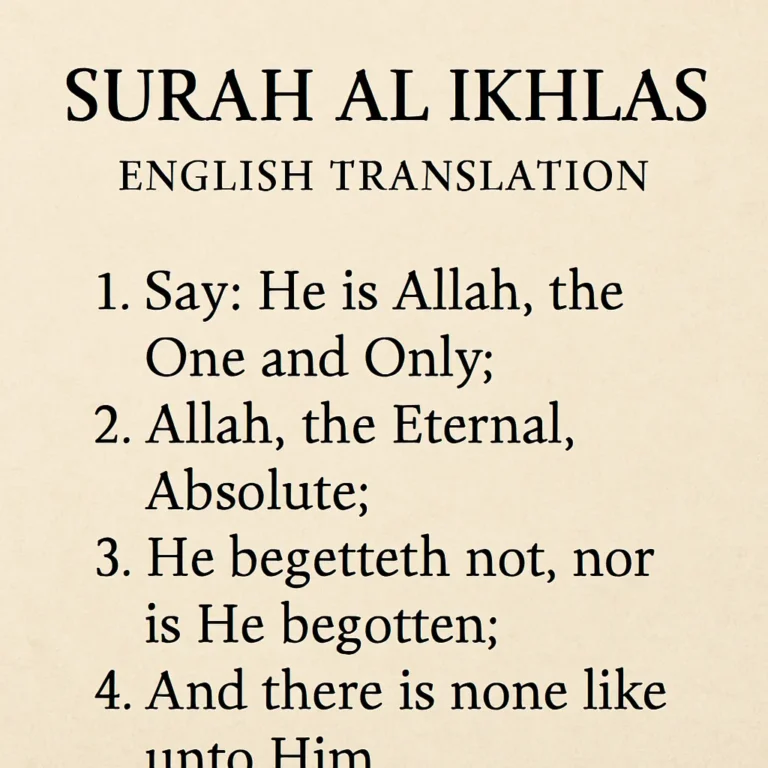
Surah Al-Ikhlas, also known as Surah 112 in the Quran, is one of the most beloved chapters
among Muslims for its concise but profound declaration of monotheism (tawhid). While the
chapter is brief—only four verses long—it contains a complete and uncompromising testimony about the nature
of Allah. In English translations, scholars and translators often render the verses with slightly
different nuances, highlighting multiple layers of meaning from divine unity to the absolute
transcendence of the Creator.
This article presents an extensive overview of Surah Al-Ikhlas with emphasis on its meaning,
its theological significance, and the varieties of English translations that
render its message into accessible language. We also explore the sound and resonance of the
surah in recitation, including audio resources and guidance for listeners who wish to explore different
reciters and styles.
Note on the Arabic text: the surah is traditionally read as part of the Qur’an’s canonical text, and the
Arabic wording carries a precise meaning that is sometimes difficult to capture fully in translation. The
English renderings aim to convey the core ideas: the oneness of God, His self-sufficiency,
and the absoluteness of His nature—without any peers, offspring, or equal
to Him.
The Arabic text above is short but densely packed with theological meaning. For readers, listening to a
reciter while following the Arabic can help connect the rhythm and cadence of the revelation with its
meanings in English.
Overview: Core Theme and Purpose
The core theme of Surah Al-Ikhlas is exactly what its name implies: a clear, concentrated declaration
of God’s unity and uniqueness. It is frequently described as a compact profession of tawhid al-asma wa sifat (the oneness of God as the One Who has Perfect Names and Attributes) in
a form that leaves no room for ambiguity. The surah’s message stands in contrast to beliefs that might imply
partners or divisions within the divine essence.
Ahad (One) emphasizes uniqueness and oneness without any plural or composite sense.
Samad (The Eternal, Absolute) points to a God who is self-sufficient and upon whom all beings depend.
The verse about not begotten and not begotten of others reinforces the idea that God has no parentage or offspring.
Finally, the claim of non-similarity (kufuwan ahad) asserts that nothing in creation is like God.
Across translations and study resources, the surah is often used in daily prayer, memorization routines, and
as a compact reminder of the nature of God. Its brevity lends itself to reflection: a single, crisp
articulation of what it means to worship the One God in a world full of multiplicity.
In English translations, the word Ahad is often rendered as “One” or “The One”.
Some translators stress that Ahad communicates absolute unity without any multiplicity, while
others emphasize a sense of indivisible wholeness in the divine nature.
Samad: The Absolute Sustaining Source
Samad is one of the surah’s richest terms. It is commonly interpreted as The Eternal, The Absolute, or The Self-Sufficient, indicating that God is the ultimate
source of all existence and the one from whom all sustenance and purpose flow. In some renditions, Samad
also carries the sense of God being the anchor for all creation—independent of creation while sustaining it.
Lam yalid, lam yulad: Begets Not, Nor Was He Begotten
These two lines express God’s unlikeness to anything else in creation. Translators vary in how they
phrase this: some use explicit phrases like “He begetteth not” and “nor was He begotten”,
while others opt for modern-language equivalents such as “He does not give birth, nor was He born.”
The essential point remains: God is not part of a family lineage and is not created. This
is a foundational rejection of polytheistic or genealogical concepts of God.
Kufuwan Ahad: No Equal to Him
The final verse affirms that there is no one comparable to Allah. Some translations phrase this as “There is nothing comparable to Him.” Others say “There is no equal to Him.” The sense is a firm
admonition against imagining any partner or mirror to the divine essence.
Variations in English Translations: Breadth and Depth
Different scholars translate Surah Al-Ikhlas with variations that illuminate several layers of meaning.
The following subsections present a broad survey of these renderings, highlighting semantic breadth while
preserving the surah’s essential message.
Common paraphrase varieties
Variant A emphasizes divine unity and singular reality: “Say: He is Allah, the One and Only; Allah, the Self-Sufficient Source of all.”
Variant B emphasizes absolute uniqueness and independence: “Say: Allah is the One—uniquely One, eternally self-sufficient.”
Variant C stresses the non-resemblance to creation: “Say: He is Allah—the One who is unlike anything else, and to whom nothing can be compared.”
Variant D frames Samad in the sense of ultimate sustenance: “Say: Allah, the Absolute, the Source of all sustenance; He neither needs nor is He in need.”
Interpreting Ahad and Samad in depth
Ahad as a theological pole: the Oneness that excludes partners, associates, or divisions.
Samad as ontological grounding: the God who supports, nourishes, and remains unaffected by anything outside Himself.
How translators handle repetition and rhythm
Some translations preserve a cadence that mirrors the surah’s concise structure, using parallel lines to reinforce unity.
Other renderings opt for slightly more literal wording to aid readers unfamiliar with classical Arabic syntax.
Older, public-domain renderings from early modern English translations often favor a traditional diction
(e.g., “Begetteth not, nor is He begotten”). Modern translations tend to employ contemporary language
while staying faithful to the Arabic meaning. Readers may consult multiple versions to appreciate how nuanced
differences in vocabulary can affect understanding, especially the nuances of divine transcendence and the oneness of God.
Interpretation History and Scholarly Perspectives
Across Islamic history, Surah Al-Ikhlas has been used in theology, exegesis (tafsir), and
devotional practice. Classical commentators such as Ibn Kathir, Al-Tabari, and Al-Qurtubi emphasize that this surah sums up the creed of pure monotheism in a compact form.
In modern scholarship, the surah is often discussed in the context of ulema debates about the nature of God’s
attributes and how divine unity should be understood in light of scriptural affirmations. Some modern exegeses
stress that the surah implicitly rejects any form of anthropomorphism or itive analogies
that risk misrepresenting the divine essence. Others highlight its role as a concise confession
that is suitable for recitation in daily life, teaching, and spiritual reflection.
Audio: Recitation, Listening, and How to Approach the Surah
Listening to recitation can deepen understanding and enhance memorizeability. A number of renowned
reciters lend their melodies and tajweed (pronunciation and articulation rules) to the surah, making it easier
to grasp the rhythm and cadence of the Arabic while reflecting on the English paraphrase meanings.
Recommended reciters and styles
Mishary Rashid Al-Afasy: clear enunciation and a melodic, soothing cadence; widely preferred for daily listening.
Saad Al-Ghamdi: a balanced, accessible voice with precise tajweed; popular among beginners and advanced listeners alike.
Mohammad Siddiq Al-Minshawi: classic recitation style with a strong, traditional cadence that many listeners find deeply moving.
Abdul Basit Abdul Samad: an iconic, classic recitation style known for its flowing and expressive tone.
Qari Yusuf Estes or other contemporary narrators: approachable for English-speaking audiences and learners.
Where to listen: platforms and resources
Quran.com offers verse-by-verse audio playback with multiple reciters and languages, including Surah Al-Ikhlas.
Islamic websites and apps provide audio libraries featuring tajweed-focused recitations and transliterations.
YouTube channels host numerous formal recordings and educational videos that explain the meanings and pronunciation.
Mobile apps specializing in Qur’an recitation often include offline audio, bookmarks, and listening playlists for Surah Ikhlas.
Surah Al-Ikhlas is commonly recited in daily prayers and in personal supplication due to its
concise, clear proclamation of God’s oneness. Beyond ritual use, it serves as a profound reminder of
several ethical and spiritual principles:
Monotheistic focus: It centers attention on the one true God, discouraging any form of associating partners with Him.
Self-sufficiency: It emphasizes that God needs nothing and that all creatures depend on Him.
Radical transcendence: It asserts that God is unlike anything in creation, ruling out comparable attributes or likenesses.
Conciseness as virtue: The brevity of the surah invites repeated reflection; a small prayer can carry immense weight in one’s spiritual life.
Practical applications for believers
Use Al-Ikhlas as a mental touchstone during moments of doubt or distraction, reaffirming tawhid.
Recite it in daily routines as a reminder that God’s unity anchors all truth claims and moral decisions.
Share the surah’s meaning with others to cultivate a broader understanding of Islamic monotheism.
Common Misunderstandings and Clarifications
Because Surah Al-Ikhlas is highly compact, readers may encounter some misinterpretations. The following
notes address frequently raised questions:
Misconception: The surah asserts that God has no attribute at all.
Clarification: The surah emphasizes that God’s attributes are unique and perfect, but in a way that
remains incomparably unlike anything in creation. The goal is to affirm unitary divinity without
implying any form of polytheism or anthropomorphism.
Misconception: The surah is not relevant to philosophical debates about God.
Clarification: While concise, Al-Ikhlas engages deeply with the question of God’s essence
and existence, making it central to both devotional practice and theological discourse.
Conclusion: The Enduring Relevance of Surah Al-Ikhlas
Surah Al-Ikhlas is a compact masterpiece of faith, philosophy, and devotion. Its English translations
demonstrate how the timeless Arabic terms can be rendered in different registers of language—ranging from
traditional reverence to modern clarity—without losing the surah’s essential theological message.
Whether studied as a piece of doctrinal articulation, used as a daily spiritual practice, or explored in
an academic setting, the surah invites readers to contemplate the nature of Allah—the
One, the Self-Sufficient, and the One without equal. By listening to diverse audio renderings and
comparing paraphrases, learners gain a richer sense of the text’s semantic breadth and spiritual resonance.
In the end, the message of Surah Al-Ikhlas remains profoundly simple and profoundly powerful: there is only One God,
and that One is unlike anything in creation. This is the heart of the surah’s exhortation, and its invitation to
every reader to contemplate the essence of faith with humility, reverence, and clarity.