Introduction to the Opening: Surah Al-Fatiha and Its Deep Significance
Surah Al-Fatiha, often rendered in English as The Opening or The Opening Chapter, holds a special place in the Qur’an and in the heart of Muslim devotion. It is frequently described as the essence or summary of the entire revelation, because it encapsulates key theological convictions, ethical orientation, and spiritual practice in a compact form. This article explores its linguistic beauty, its theological meanings, and its practical significance—especially in acts of worship such as daily prayers, where its recitation is a constant and central ritual.
Across schools of thought and across translations, Surah Al-Fatiha is surrounded by layers of meaning. It is not only a text to be read but a mode of orientation—a declaration of ultimate worship, a request for guidance, and a remembrance of God’s mercy and bounty. In a single seven-verse sequence, it moves from praise and gratitude to direct supplication for a straight path, and it concludes with a recognition of the moral and spiritual directions that lead toward blessing rather than misguidance.
Transliteration helps bridge the gap when Arabic script is not available or when readers seek a phonetic guide. There are several common transliteration forms for the opening lines, and these variations often reveal subtle differences in pronunciation or emphasis. Here are representative transliterations of the vowels and consonants you will encounter:
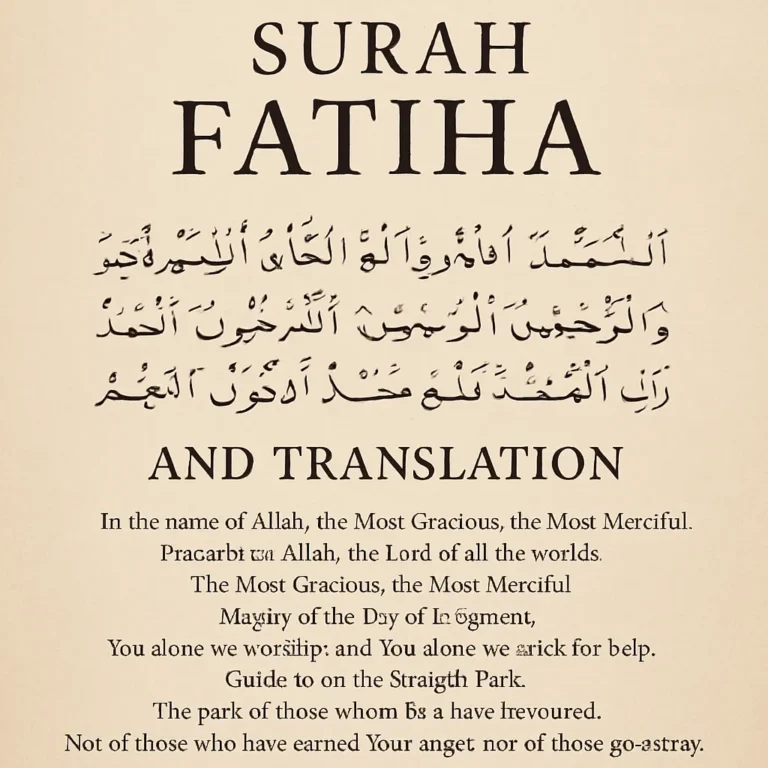
Bismillāhir-Raḥmānir-Raḥīm — “In the name of God, the Most Gracious, the Most Merciful.”
Al-ḥamdu lillāhi Rabbi l-‘ālamīn — “All praise is due to God, Lord of the Worlds.”
Ar-Raḥmānir-Raḥīm — “The Most Compassionate, the Most Merciful.”
Māliki yawmid-dīn — “Master of the Day of Judgment.”
Īyyāka na‘budu wa īyyāka nasta‘īn — “Thee alone we worship, and Thee alone we ask for help.”
Iḥdina ṣ-ṣirāṭa l-mustaqīm — “Guide us to the straight path.”
Ṣirāṭa lladhīna an‘amta ‘alayhim ghayri l-maghdūbi ‘alayhim wa lā ḍ-ḍāllīn — “The path of those upon whom You have bestowed favor, not of those who have earned Your anger, nor of those who go astray.”
To illuminate semantic breadth, we present brief renderings from several widely cited English translations. Note how basic nouns, qualitative adjectives, and implications of direction shift in wording, while preserving the core meaning.
Sahih International: “In the name of Allah, the Entirely Merciful, the Especially Merciful. All praise is due to Allah, Lord of the worlds. The Entirely Merciful, the Especially Merciful, Master of the Day of Judgment. Thee we worship, and Thee we ask for help. Guide us to the straight path, the path of those upon whom You have bestowed favor, not of those who have earned Your anger nor of those who go astray.”