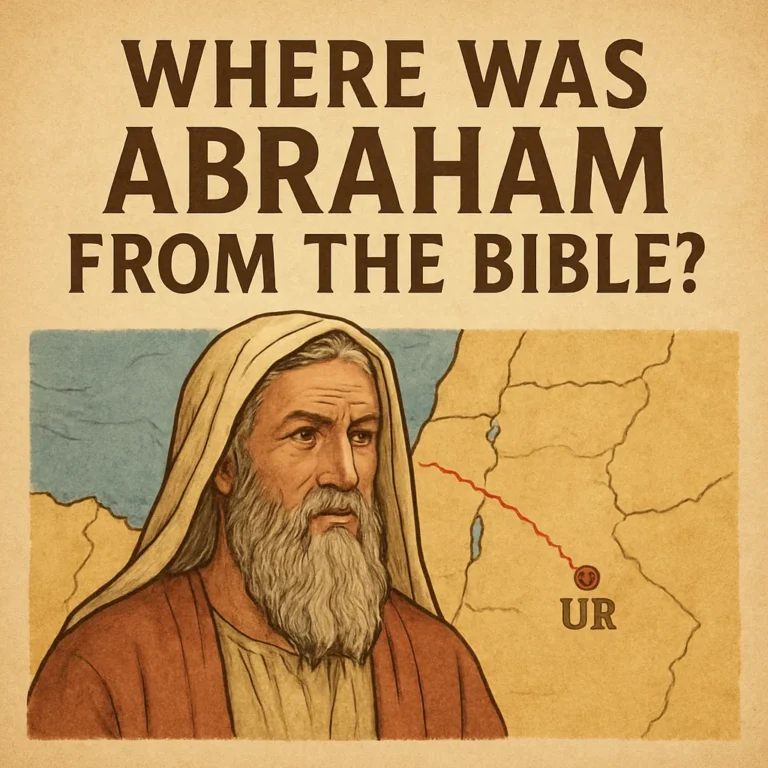
Where Was Abraham From in the Bible? Origins, Geography, and Context
The question “where was Abraham from in the Bible?” opens a broader inquiry into the
origins, travels, and theological significance of a foundational patriarch. Across the biblical text, a
number of phrases and place-names compete for attention as Abraham’s homeland and starting point in the
biblical story. In this article we will explore Abraham’s origins, map the places often
proposed as his ancestral homeland, examine the narrative trajectory from Ur to Haran and
then to the land of Canaan, and situate these movements in their historical and theological context. We will use
variations of the question “where was Abraham from in the Bible” to reflect the way scholars and readers express
this issue in different formulations.
Origins and Names: From Abram to Abraham
One of the first layers to the question of origin concerns names and identity. In the biblical text, the patriarch
is introduced as Abram, later named Abraham (Genesis 17:5). The name change is
itself meaningful, signaling a covenantal enlargement of the promise and the role he would play in the
biblical narrative. When people ask where was Abraham from in the Bible, they are often asking first
about the language and cultural milieu implied by his ethnos and homeland.
Abram is the name used in the early chapters of Genesis, reflecting a familial and tribal
identity in a Mesopotamian setting.
When God called him and established a covenant, his name becomes Abraham, signifying “father
of a multitude” and a more expansive future mission.
The shift in naming mirrors a shift in geography and vocation—from a personal lineage to a people that God would bless.
The core question—where is the origin of this figure in the biblical narrative—must be read in
light of both the genealogical line and the historical geography that frame his life. While the name “Abraham”
emerges as a covenantal marker, the initial setting of his story involves particular places that the text
regards as crucial to his identity and calling.
Geography and the Immediate Context: Ur, Haran, and the Land of Canaan
The most prominent geographical anchors in the Abraham story are Ur of the Chaldees, the
place of his father Terah’s family origins, and Haran, a city in Upper Mesopotamia that becomes
a staging post before the family’s voyage toward Canaan. The land of Canaan is the ultimate
destination and the locus of the covenantal promises given to Abraham.
In the biblical map, these places lie along a trajectory that looks something like this: a Mesopotamian
origin in the south-central region, a migration northward to Haran, and then a westward move from Haran to
the land God would show him. The audience is invited to consider not only the physical geography but also the
theological geography—how space is invested with divine purpose and how movement opens a new stage of
relationship between God, Abraham, and his descendants.
Ur of the Chaldees: The Starting Point in Genesis 11
The name Ur of the Chaldees appears in Genesis 11:28‑31 as part of the genealogical bridge that
carries Abram from Terah to a new future. The phrase indicates a concrete location in southern Mesopotamia, a
region known for early urban civilization. The text attributes to Terah the decision to migrate with his
household to the land of Canaan, but their journey halts in Haran for reasons that are not fully
explicit in the narrative.
The move to Haran—a city in Upper Mesopotamia near the Balikh and Euphrates rivers—functions as a
historical pause in the Abraham story. In Genesis, Terah dies in Haran, and it is from that city that
God speaks again to Abram and prompts the final westward migration into Canaan (Genesis 12:1‑9). For many readers
and scholars, Haran serves as a hinge between the homeland of origin and the promised land.
The Promised Land: Canaan as Destination and Theological Destination
The land of Canaan becomes the ultimate geographic and theological horizon of the Abraham narrative.
God’s words to Abram in Genesis 12:1–3 reframe the destination as a place of blessing for him and for all the families
of the earth. The geography of the promise is inseparable from its theological content: the land becomes the stage
on which God’s covenantal purposes unfold, and the narrative invites readers to connect Abraham’s origin with a future
people and a stabilized presence in a land promised by God.
Chronology, Routes, and the Geographic Argument: How the Biblical Text Frames Abraham’s Origins
When scholars ask “where did Abraham come from according to the Bible?” they are engaging with how
the text situates him in a chain of places, peoples, and promises. The chronology is compact and, at points, terse:
The ancestral home is located in Ur of the Chaldees, a city that is described as part of the
wider Mesopotamian world.
A movement to Haran with Terah and the family, marked by continuity with urban life in Mesopotamia.
A divine command to travel to the land of Canaan, followed by a westward relocation and a
sustained encounter with the land God will give to Abram and his descendants.
In this sequence, the origin is not only a matter of birthplace but also of lineage, vocation, and covenantal
purpose. The question where is Abraham from in the Bible thus invites a layered answer: the physical
geography of southern Mesopotamia, the social geography of Ur and Haran, and the theophanic geography of the land
of Canaan as the stage for divine promises.
What Counts as an Origin? The Variant Readings
Some readers ask whether Ur is the sole birthplace attributed to Abraham, or whether the elder
patriarch’s origin is more properly understood as a broader Mesopotamian milieu that includes
Haran as a homeland of origin in a narrative sense. Others stress that the genealogical genealogy in Genesis 11
emphasizes a lineage rather than a precise birth certificate. The result is a nuanced view: Ur is
commonly cited as the classical origin in the biblical tradition, while Haran is understood as part of the
formative geography of Abram’s early life.
Regional Identification and Modern Geography
Ur of the Chaldees is widely identified with the ancient city near modern Nasiriyah in Iraq. The classic
identification situates Ur in the southern Mesopotamian plain, a hub of early urban settlement. Haran, by
contrast, is associated with a city near Şanlıurfa in present-day southeastern Turkey. These
identifications reflect the broad scholarly effort to map biblical places onto known archaeological and historical
locations, while acknowledging that precise borders and political boundaries shifted across centuries.
Historical-Critical and Theological Context: Why Origin Matters
The question where was Abraham from in the Bible intersects both historical-critical
scholarship and theological interpretation. For students of history, the focus is on the social world of Ur,
the urban networks of Haran, and the ancient Near Eastern milieu in which patriarchal narratives
are set. For theologians, the concern is how origin relates to covenant, faith, and obedience—how place becomes a
stage for divine action.
Some scholars view the Abraham stories as a composite of earlier material and later redaction, arguing that the
geographic frame serves to relate a chosen people to their ancestral homeland. In this view, the precise identity
of Abraham’s birthplace may be less important than the way ancient editors used place-names to convey identity,
exile, and divine promise.
Thematic and theological perspectives
Theologically, origins are inseparable from covenant faith and divine promise.
The movement from a Mesopotamian origin toward Canaan is not simply a migration; it is the
beginning of a narrative about how God engages with a particular family to bless all nations. The origin, then, is
a kind of divine invitation that structures the entire storyline.
How different traditions read the origin question
In some Jewish and Christian traditions, the emphasis is on calling and covenant, with the homeland framing the
location where God’s people begin their journey of faith.
In other scholarly traditions, the emphasis is on geography and archaeology, seeking to locate the places
named in Genesis and to understand their place in the broader ancient Near Eastern world.
In interfaith contexts, the origin question can engage with how different communities understand the figure of
Abraham and his significance for faiths that trace lineage to him.
In Genesis: Key Passages That Shape Our Sense of Origin
Several pivotal passages anchor the discussion of Abraham’s origin. By examining Genesis chapters
11 through 15, readers can trace how the text defines origin, movement, and vocation.
Genesis 11:31–32; 12:1–9
These verses couple the departure from Ur with the ascent toward the land God would show him. The narrative marks
both a familial decision and a divine launching of a covenantal journey. The command to go forth and the promise to
bless create a framework in which origin becomes destination and vocation.
Genesis 12:4–9: The Call and the Land of Promise
In this crucial episode, Abraham’s obedience to the call is tested by geography. The land of Canaan emerges
as the promised space where the covenant will take shape. The land is not merely a map; it is a stage for divine
intervention, testing, and the unfolding story of a people.
Genesis 11:26–32 and 12:4–5: Family and Faithful Ancestry
The genealogical background, including the line from Terah to Abram, helps readers understand origin as a family’s
beginning that becomes a religious-political identity. The archaeological and literary layers together show how a
homeland becomes a founding myth and a covenantal framework.
Beyond the Text: The Broader Context of Abraham’s Origins
The location and origins of Abraham have inspired a host of interpretive angles outside the biblical pages.
Whether one approaches the material as a believer, a scholar, or a student of ancient worlds, the origins of
Abraham remain a touchstone for questions about identity, faith, and the movement of peoples in antiquity.
Archaeology and the Mesopotamian setting
Archaeologists and historians often discuss the Mesopotamian cradle as the broader setting of
Abraham’s origin, even as they acknowledge the challenges of identifying a precise birthplace. The southern Mesopotamian
plain, with Ur at its heart, is a region associated with early urban life, writing, and complex civil institutions.
Comparative ancient Near Eastern literature
When the question where was Abraham from in the Bible is asked in light of similar narratives in the
region, readers may notice shared motifs—mandates to migrate, promises of offspring, and conflicts over land.
Such comparative readings illuminate how the Abraham story participates in a wider cultural conversation about
kinship, oath-taking, and divine blessing.
Later Jewish, Christian, and Islamic traditions all engage with the origin story in ways that emphasize
Abraham’s universal mission and his role as a model of faith. The question of origin thus
resonates across religious communities as a way to reflect on where a people began and why those beginnings
matter today.
Frequently Asked Variations on the Theme: Different Ways to Ask About Abraham’s Origin
To satisfy readers who use varied search phrases, here are several restatements of the same underlying issue.
They show how where was Abraham from in the Bible can be framed in different terms, each with
its own emphasis.
Where did Abraham originate in Genesis? Focus on the earliest chapters and the transition from
Abram to Abraham.
What is Abraham’s homeland in biblical narrative? Emphasizes the place-based identity and its
significance for the covenant.
Which land is identified as Abraham’s birthplace? Points to Ur of the Chaldees as the common
traditional identification.
Where was the patriarch born in ancient Near Eastern literature? Connects to broader regional
settings and parallels with other patriarchal narratives.
Common Questions and Theological Reflections
Is Ur the definitive birthplace of Abraham?
In most traditional readings, Ur of the Chaldees is treated as the canonical locus from which
Abram originated. Yet the narrative also emphasizes a call that leads him away from Ur into the land of Canaan.
Thus, Ur is the standard answer in the text, while Haran and the promise to move to Canaan remind
readers that origin is inseparable from vocation.
Why does the location matter for faith and identity?
The geographic frame gives shape to the concept of faith as a journey. The test of obedience, the promise of blessing,
and the movement toward a divinely designated homeland all hinge on how readers imagine the starting point of the story.
The question how origin shapes destiny is therefore not just a matter of cartography, but of spiritual narrative.
How do different traditions treat Abraham’s origin?
Across Jewish, Christian, and Islamic readings, Abraham’s origin is a shared point of reference that gains meaning
through covenant, promise, and divine encounters. Each tradition may emphasize different facets—ancestry, faith, or
obedient risk—yet the origin remains a focal element in how Abraham’s life is interpreted.
Conclusion: The Significance of Abraham’s Homeland in Biblical Theology
The question about where Abraham was from in the Bible invites us into a layered exploration. The
patriarch’s origins point to a concrete geography—Ur in southern Mesopotamia—while the
narrative also reveals how place becomes destiny through the divine calling to Canaan, the land God
would show him. The journey from the ancestral homeland to the promised land is not only a physical itinerary but
a theological arc that frames the rest of the biblical story: a promise that blossoms into a people, a land, and a
blessing for all nations.
So, when readers ask where was Abraham from in the Bible, the best answer is not a single city or a crisp birthplace
but a spectrum of geography, lineage, and vocation. The homeland of Abraham is a composite: the Ur of the
Chaldees as the traditional origin, Haran as a transitional setting, and Canaan as the land of
covenant and calling. In that sense, Abraham’s origin is less about a precise coordinate than about the drama of God’s
purposes moving through space and time to bless the world.
Key takeaways:
The biblical portrait presents a multi-stage geography: Ur, Haran, and Canaan.
The names Abram and Abraham signal a shift from clan identity to covenant vocation.
The origin is inseparable from the divine promise and the unfolding story of biblical faith.
Different scholarly and faith traditions offer varied emphases, but the central theme remains: origin as a starting
point for a life of faith and mission.