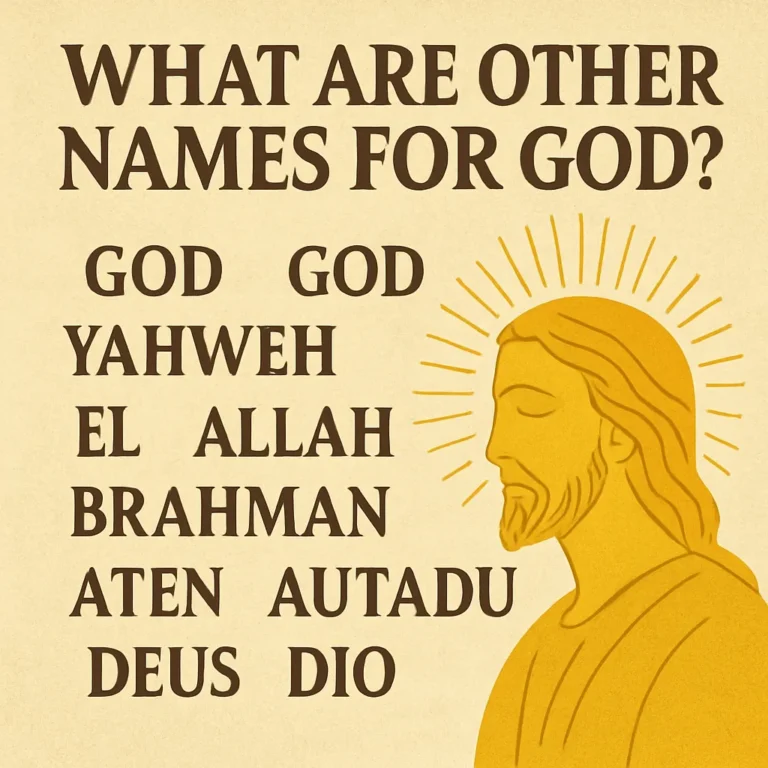
Across dozens of languages and countless cultures, people have sought to name the divine in ways that reflect attributes, roles, and relationships with humanity. The question “what are other names for God?” invites a broad survey of terms that function as epithets, titles, or
real names in different religious traditions. Rather than presenting a single canonical name, many faiths offer a family of divine names—each shade of meaning capturing a facet of the ultimate reality.
This guide aims to be comprehensive yet respectful, presenting a balanced overview of major religious
traditions and their most widely used names for the divine. It emphasizes not only the etymology of each name but also
the historical context, the theological significance, and the practical usage
in prayer, liturgy, and daily life. While many sections will name specific terms, the overarching question remains—
how do these names help believers relate to the sacred, and what can we learn from the varieties of naming
across cultures?
The Concept of Names for the Divine
Names for God are not merely tags; they are conceptions of power, modes of presence, and paths to contemplation. In many traditions, a name is believed to disclose something about
the nature of the divine: a name may reveal mercy, justice, wisdom, transcendence, sovereignty, or immanence.
It is also important to recognize that in some faiths, a name is not a private label but a sacred
utterance within a community. In others, the divine name is considered so holy that it is uttered only in
specific religious contexts, or it is spoken with particular reverence and ritual purity. The diversity of practice
reflects a broader truth: names are living expressions of belief, often carrying ritual weight,
poetic resonance, and moral imagination.
What counts as a “name” of the divine?
Proper names (the given names that identify a deity in a tradition, such as Yahweh or Allah)
Epithets (descriptive phrases that function like titles, e.g., The All-Wise, The Merciful)
Attributes (characteristics attributed to the divine, such as Lord, Creator, Sustainer)
Titles (roles the divine plays within a cosmology, such as Judge, Redeemer, Preserver)
Forms in liturgy (names used in prayer, hymns, creeds, and sacraments)
Names of God in Major Traditions
Judaism: Yahweh, Elohim, Adonai, and More
In Jewish tradition, the divine name is treated with special reverence. The most sacred name revealed in the Hebrew
Bible is often referred to as the Tetragrammaton, transliterated as YHWH or rendered as Yahweh in scholarly work. Because of the sanctity attached to this name, observant Jews traditionally
substitute Adonai (the Lord) or Hashem (the Name) in everyday speech and reading.
Beyond Yahweh, a rich set of divine names and attributes appears in Jewish liturgy and scripture, including Elohim (often rendered as God or gods, depending on context), El Shaddai (God Almighty), El Elyon (God Most High), and El Olam (the Everlasting God). Each term carries its own nuance: Elohim emphasizes power and sovereignty; El Shaddai carries connotations of nourishment and sufficiency; El Elyon points to supreme authority; El Olam signals timeless permanence.
Adonai and HaShem illustrate how Jewish communities negotiate the tension between intimate
reverence and public worship. In daily practice, these names encode a worldview in which the divine is not a distant
abstraction but a living relation to the world.
In Christian theology, God is often addressed as Theos (God) in Greek, and Kyrios (Lord) in both
Greek and Latin translations of Scripture. The personal name of Jesus—Yeshua in Hebrew, Jesus
in Latinized forms—reflects the incarnational dimension of Christian belief: God becomes accessible in the Word made flesh.
Christian usage also includes many titles that function as divine names in worship and devotion, such as Abba (Father), El Shaddai as in the Hebrew tradition, and Jehovah or Jehovah-Jireh (the LORD will provide) in certain faith communities. In addition, many Christian traditions speak of
the Three Persons of the Trinity—Father, Son, and Holy Spirit—each with resonant names and affirmations
about the divine presence in creation, redemption, and sanctification.
Within Christian devotional literature, especially in prayer and hymns, you will encounter countless epithets
for God and for Christ: the Good Shepherd, the Light of the World, the Savior, the Almighty, the King of Glory, and the Prince of Peace. These forms emphasize
the ongoing relationship between the divine and human life, inviting believers to recognize God’s presence in history and
in personal experience.
Islam: Allah and the 99 Names (Asma’ ul-Husna)
In the Islamic tradition, the divine name most central is Allah, a term that Arabic-speaking Muslims use to refer to
the one God who transcends creation yet is intimately involved with it. Muslims also read and recite a set of proper names or attributes known as the Asma’ ul-Husna (The Most Beautiful Names).
The 99 Names include attributes such as Ar-Rahman (The Compassionate), Ar-Raheem (The Merciful), Al-Malik (The King), Al-Quddus (The Holy), Al-Aziz (The Mighty), and Al-Ghaffar (The Forgiver). These epithets are not merely decorative; they shape daily practice,
prayer, and the ethical life of believers. Reciting or reflecting on these names is believed to cultivate awareness
of God’s presence and attributes in all aspects of creation.
In Islamic theology, names and attributes are distinct from essence: God’s essence is ultimately beyond
human comprehension, while the names describe will and action within creation. Nevertheless, the names serve
as a bridge—a way for believers to approach the divine in prayer, supplication, and ethical reflection.
Hinduism: Brahman, Ishvara, and a Multitude of Forms
Hindu thought offers a remarkably diverse nomenclature for the divine, ranging from the impersonal to the personal. The
term Brahman denotes the ultimate, formless reality that pervades all existence. It is not a
simple name but a metaphysical principle describing the source and substance of the universe.
Alongside Brahman, Hinduism speaks of Ishvara (a personalized, sovereign lord who governs the cosmos) and a
vast pantheon of personal deities—Vishnu, Rama, Krishna, Shiva, Durga, Sarasvati, and many others. Each form is believed to reflect aspects of the one, supreme
reality in different contexts and communities.
Names like Bhagavan (Blessed Lord), Paramatma (Supreme Soul), and Ishta devata
(one’s chosen deity) illustrate how diverse naming functions within devotion (bhakti), philosophy (advaita, dvaita, samkhya),
and ritual.
Other Traditions: Buddhism, Jainism, Sikhism, and Indigenous Faiths
In Buddhism, the focus is often less on a creator God and more on enlightened beings, dharma, and the
potential for awakening. Names like Amitabha (Infinite Light) and Mahātrāyatā (Great Vehicle
Bodhisattvas) appear in devotional and cosmological contexts. People sometimes refer to the divine through epithets that
express compassion, wisdom, or enlightenment, even when a personal creator is not central to a given tradition.
In Jainism, the focus is on liberated beings who inspire ethical living and spiritual progress rather than
a supreme creator god. Names and titles reflect reverence for infinite knowledge, perfect perception, and pure conduct.
Sikhism uses names such as Waheguru (Wonderful Teacher, Wonderful God) and emphasizes
the unity of the divine in Ik Onkar (One Creator). The Sikh tradition often speaks of the divine with names
that highlight light, truth, and eternal presence.
Across many Indigenous and regional traditions, names for the divine frequently emerge from cosmology, ancestry, and the natural world. Epithets may describe spirits of the land, sky, or water, or refer to
ancestor figures who embody protective power and moral order.
Names for God in Everyday Language
People often use everyday language to speak of God in ways that feel intimate and practical. These
expressions can be found in prayer, music, and daily conversation. Some examples include:
Lord or Lordship as a relational address in Christian and other traditions
Creator or Sustainer to emphasize the origin and maintenance of existence
Merciful, Compassionate, and Just to highlight moral attributes
Mother/Father of All in devotional poetry that uses familial language to describe divine care
Mother Earth or Father Sky in certain indigenous frameworks that personify the divine in nature
Theological Significance of Divine Names
Names for God carry profound theological implications. They shape how communities understand divine
action, human destiny, and moral obligation. Some key themes include:
Relationality: Names often express a relationship between the divine and humans, such as Father–Child, Lord–Servant, or Friend–Beloved.
Transcendence and Immanence: Some names emphasize the distant, holy nature of God; others highlight God’s closeness and accessibility.
Mercy and Justice: Epithets frequently balance compassion with righteousness, reminding believers of both mercy and accountability.
Creation and Redemption: Names can signal creative power, liberating action, or future hope of salvation or liberation.
Ethical Orientation: The divine names often call adherents to imitate virtues such as humility, mercy, truthfulness, and generosity.
How to Engage Responsibly with Divine Names
When exploring or using the many names of God, consider the following principles of responsible engagement:
Context matters: Use names appropriate to the tradition, setting, and audience. Not all names are suitable in every context.
Respect for sacredness: Some names carry ritual weight. Handle them with reverence and awareness of communal norms.
Educational purpose: Seek to understand the etymology, history, and theology behind names rather than superficial associations.
Ecumenical curiosity: Appreciate how different faiths illuminate universal questions about meaning, power, and reverence.
Personal reflection: Names can serve as lenses for meditation, prayer, or ethical reflection—use them to grow in virtue and compassion.
Semantic Variants: A Guide to Phrases That Explain the Divine Name
If the central question is “What are other names for God?”, the answer is not a single list but a
dynamic repository of semantic fields that describe the divine. Here are several useful semantic
categories you will encounter:
Names of sovereignty (King, Lord, Ruler)
Names of mercy (Merciful, Compassionate, Forgiving)
Names of providence (Creator, Sustainer, Nourisher)
Names of knowledge (All-Knowing, All-Wise, Omniscient)
Names of sanctity (Holy, Pure, Sacred)
Names of presence (Immanent, Nearer, Within)
Recognizing these categories helps in comparing traditions and understanding how communities translate
abstract metaphysical realities into communicable reverence and ethical aspiration.
When you encounter a particular name, ask: What attribute or relationship does this name emphasize?
Case Studies: Selected Names and Their Meanings
Yahweh and Elohim: Two Senses of the Divine in Ancient Texts
Yahweh is the personal name of God revealed to the people of Israel in biblical narrative and covenant theology.
It connotes a dynamic presence among the people, often translated as “the one who is” or “I will be who I will be”. Elohim is a more general term for God that emphasizes power and sovereignty in the created order. The
juxtaposition in scripture invites readers to contemplate both the intimate relationship of the divine with humanity and the
vast, cosmic authority of the divine over all things.
Theos and Kyrios: Greek Foundations of Christian Names
In early Christian usage, Theos functioned as “God” in Greek, while Kyrios signified
“Lord” as a title of authority and relationship—especially in relation to Jesus Christ. The baptismal and liturgical
traditions broadened the vocabulary to include sacred titles such as Abba (Father) and Hosanna
(an exclamation of praise). The multiplicity of names mirrors the multifaceted work attributed to the divine in Christian
faith: creation, redemption, justification, sanctification, and eschatological hope.
Allah and the 99 Names: A Practice of Prayer and Reflection
The Islamic tradition presents Allah as the universal, indivisible divine reality. The accompanying 99 Names provide a practical framework for prayer and contemplation. Each name invites believers to reflect on a
specific attribute of God and to model that attribute in daily life—mercy in acts of kindness, justice in social conduct,
patience in personal trials, and gratitude in all circumstances.
Hindu Epithets: From Brahman to Bhagavan
In Hindu thought, Brahman speaks to the ultimate, unnamed source of all that exists. Ishvara shifts the
focus to a personal, approachable form that governs the world. Names such as Krishna, Rama, and Vishnu represent different manifestations of the divine in relation to cosmic order (dharma). The devotional
practice of naming—saying a deity’s name with devotion—embodies a powerful spiritual habit in which language becomes
a doorway to experience.
Sikhism: Waheguru and Ik Onkar
In Sikhism, the central divineName Waheguru communicates the ineffable radiance of the Supreme Being. The
mystical formula Ik Onkar proclaims the oneness of the Creator—an anthem of unity, truth, and the
transcendence of dualities. Together, these names encapsulate a vision of God as both immanent in life’s struggles and
utterly transcendent.
Indigenous and Global Perspectives: Names from the Land and Cosmos
Across indigenous communities and global cultures, divine names often arise from the land—earth, wind, rivers, trees—and from
ancestral figures who embody moral authority and stewardship. These names reflect a relational cosmology in which the sacred
is woven into daily life and the natural world. Even when the language differs, the impulse to name the divine in terms of
care, reciprocity, and wonder remains a common thread.
Conclusion: The Living Word of Divine Names
The broader question, “what are other names for God?”, does not yield a finite catalog but a living
map of humanity’s attempts to touch what lies beyond ordinary experience. Names are tools for contemplation, conduits for worship, and invitations to ethical living. They remind believers that the divine
is not a single static label but a presence that speaks through history, culture, and personal experience.
Whether we study Yahweh in the Hebrew Bible, Allah in the Qur’an, Theos in Christian
scripture, Brahman and Ishvara in Hindu thought, or Waheguru in Sikh devotion, the
naming of the divine becomes a way to reflect on what is most deeply meaningful, most eternally true, and most profoundly
transformative in the human quest for meaning.
In a world of diverse beliefs, the study of divine names can become a bridge for dialogue rather than a
source of division. By approaching names with curiosity, humility, and reverence,
readers can gain insight into how different communities experience the sacred and how those experiences can inform
universal human values such as compassion, justice, and care for creation.