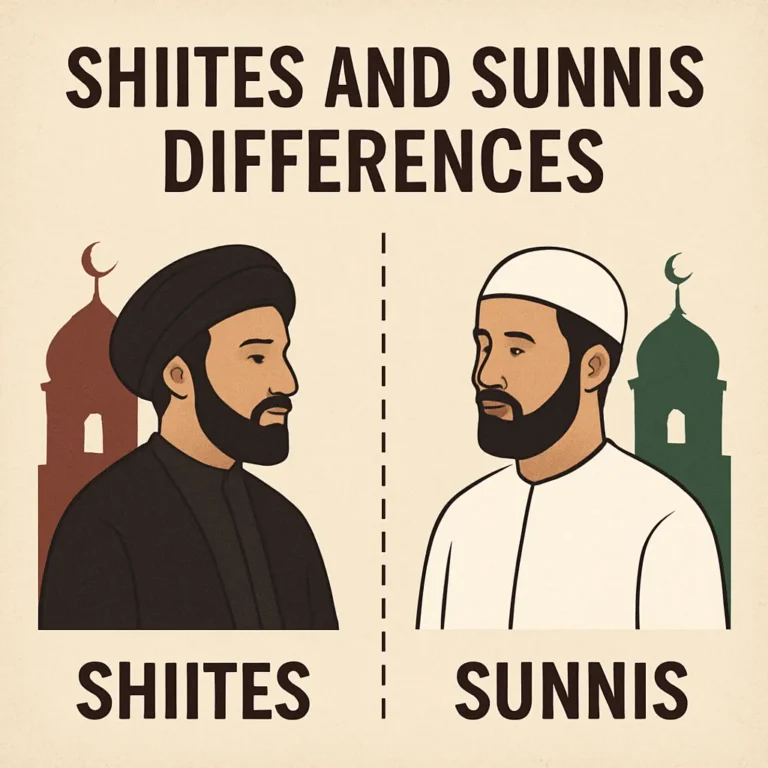
This article offers a comprehensive guide to the differences between Shiites and Sunnis, presenting their beliefs, history, and daily practices in a balanced and accessible way. The terms Shiite/Shia and Sunni refer to two large and historically rooted streams within Islam. They share the core faith, but they emphasize different theological concepts, leadership models, and jurisprudential traditions. This guide uses clear language, acknowledges diversity within each group, and highlights how both communities live their faith in many places around the world today.
At a high level, Shiites (also written as Shia or Shi’a) and Sunnis represent two major ways Muslims understand prophetic authority, leadership, and the interpretation of religious law. Both communities regard the Quran as sacred and hold the core pillars of Islam—profession of faith, prayer, charity, fasting, and pilgrimage—to be central. Yet they differ in how they understand leadership after the Prophet Muhammad, how authority is transmitted, and how jurisprudence is developed and practiced.
In everyday language, you will see terms such as Shia/Sunni divide, Shiite/Sunni communities, or Shias vs. Sunnis used interchangeably in media and scholarship. This article uses multiple variants to reflect common usage and to broaden semantic reach: Shiites, Shias, Shia Muslims, Sunnis, Sunnite, and Sunni Muslims.
Historical Roots: The Schism and Its Aftermath
The dividing moment between what would become the Shiite and Sunni traditions happened in the early decades of Islam, around questions of succession and leadership after the Prophet Muhammad’s death in 632 CE. While both communities share a belief in God, in the prophethood of Muhammad, and in the Qur’an, they diverge on how the Muslim community should choose its leaders and how authority should be exercised and transmitted.
Key turning points in brief
Dispute over succession: Many early Muslims supported the appointment of Abu Bakr as Caliph, while a segment believed that Ali, the Prophet’s cousin and son-in-law, was divinely chosen. This initial disagreement seeded deeper theological and political differences.
Caliphate vs Imamate: For Sunnis, the caliphate emerged as a political and religious leadership chosen by the community or its elders. For Shiites, the concept of Imamate emphasizes a divinely guided line of leaders starting with Ali and continuing through his descendants.
Karbala and martyrdom: The 680 CE death of Husayn ibn Ali at Karbala became a central event for Shia identity, symbolizing steadfastness, justice, and moral resistance against tyranny. This tragedy shapes Shiite devotion and ritual commemorations, especially during Ashura.
Institutional development: Over centuries, Sunnis developed jurisprudential schools known as madhahib (e.g., Hanafi, Maliki, Shafi‘i, Hanbali), while Shiites developed a distinct legal and theological framework centered on the Ja’fari school and later clerical structures.
The result of these early divergences is a rich tapestry of beliefs and practices within both streams. It is important to recognize that there is considerable internal diversity within Shiite and Sunni communities, and most adherents emphasize shared foundations while respecting differences.
Theological Foundations: Core Beliefs and Sources of Authority
The two traditions share belief in one God, Prophet Muhammad as the final messenger, and the Quran as the central scripture. Yet they approach authority, revelation, and jurisprudence through different lenses.
Authority and leadership
In Sunnism, leadership after Muhammad is understood as a matter of practice and community consensus (though not unanimous). The early generation recognized a succession of caliphs who governed political and, to varying degrees, religious life. Over time, four main jurisprudential schools emerged—Hanafi, Maliki, Shafi‘i, and Hanbali—each with its own methods of deriving law from the Qur’an and hadith, and its own sense of authority within the community.
In Shia Islam, leadership is conceptualized as an Imamate, a divinely guided lineage beginning with Ali and continuing through his descendants in the Imami tradition. The Imams are seen as trustworthy guides who possess special spiritual authority and, from the perspective of many Shiites, are the rightful interpreters of theological and legal matters. The Twelver branch, by far the largest Shiite group, holds that there have been twelve Imams, the last of whom is in occultation and will return as the Mahdi to lead just rule.
Quran – the foundational scripture for both streams, revered as God’s revealed word.
Hadith – accounts of the Prophet’s sayings and actions, with different hadith collections revered in Sunni and Shiite circles.
Ijma (consensus) – widely emphasized in Sunni jurisprudence as a source of doctrinal and legal authority, though interpreted differently in various madhahib.
Qiyas (analogy) – a method of deriving jurisprudence by analogy; its use is more central in Sunni legal tradition, while Shiite jurisprudence often emphasizes the guidance of the Imams and the mujtahids with a different approach to independent reasoning.
Marja’ al-taqlid (source of emulation) – in Twelber Shiism, senior clerics function as authoritative sources for legal rulings and spiritual guidance, enabling followers to practice religious duties in complex issues.
Key theological concepts
Ahl al-Bayt and devotion to the Prophet’s family are especially prominent in Shiite practice, where reverence for Ali and the Imams is central.
Imamate as a divinely guided leadership principle is a cornerstone for many Shiites, while Sunnis emphasize a community-based leadership model and the consensus of the companions of the Prophet.
Occultation in Twelver Shiism refers to the belief that the 12th Imam is in hidden life and will reappear to restore justice. This is a defining eschatological element for many Shia, though it is not shared in the same form by Sunnis.
Lived Practices: Worship, Rituals, and Daily Life
While there are shared rituals in both streams of Islam—such as the five daily prayers, fasting during Ramadan, zakat, and the obligation of Hajj—the way these acts are performed and the customs surrounding them can differ.
Prayer and ritual forms
Prayer posture: Sunnis generally adopt one of several prescribed positions, often with hands folded in front of the chest or abdomen depending on the school, while many Shiites prefer hands to be at the sides and follow slightly differing sequences. Variations exist, but both groups recite the Adhan (call to prayer) and Iqama as part of the worship.
Prostration: Shiites commonly place the forehead on a clay turbah (often made from soil or clay) during prostration. Sunnis typically use the prayer mat or ground itself, without the turbah, though there are rites of prostration that may involve natural soil in some communities.
Ritual calendar and commemorations
Ashura and related ceremonies are a defining feature of Shiite practice, marking Husayn’s martyrdom at Karbala. These events include processions, lamentation, and ritual remembrance, which are deeply meaningful for many Shiites and form a distinctive identity marker.
In Sunni communities, Ashura is observed as a day of fasting for some, following the Prophet Muhammad’s reported practice, but it generally lacks the same-scale mourning rituals found in many Shiite communities.
Ziyarat (pilgrimage to holy sites) is emphasized within Shiite practice, particularly visits to shrines of the Imams and saints. Sunni engagement with shrine visitation varies widely and is often more restrained in certain contexts.
Moral and devotional life
Khums and other charitable obligations: Some Twelver Shiites observe khums (a 20% levy on certain income, usually split between charitable works and religious leaders), alongside zakat. Sunnis observe zakat more uniformly as one of the five pillars, with a tradition of giving to the needy and supporting the community.
Fasting and Ramadan: The basic Ramadan fast is shared, but some cultural practices around feasting, community meals, and nocturnal prayers (shab-e-qadr, nightly prayers) may take distinct forms in Shiite and Sunni communities.
Dietary and ritual purity practices: While both streams adhere to the core dietary laws of Islam, there can be minor differences in practices around ritual purity and sacred spaces, largely shaped by jurisprudential schools and local customs.
Hanafi – known for its flexibility and emphasis on reasoned opinion (ijtihad) in many contexts; widespread in South Asia, Turkey, the Balkans, parts of the Middle East, and beyond.
Maliki – strong in North and West Africa, with jurisprudence anchored in the practices of the people of Medina and the sunna.
Shafi‘i – influential in East Africa, Southeast Asia, and parts of the Arabian Peninsula; emphasizes hadith and systematic methodology.
Hanbali – considered the most textually strict among the four, with a focus on the Qur’an and hadith; prevalent in parts of the Arabian Peninsula and certain other regions.
Shiite jurisprudence: Ja‘fari and Usuli traditions
Ja‘fari school (also called Usul al-fiqh in Shiite contexts) forms the backbone of Twelver Shia jurisprudence, emphasizing inference by qualified jurists and the guidance of the Imams (historically and in principle).
Usul and furū‘ (principles and branches) describe the system through which jurists establish rulings, with a strong emphasis on reasoned ijtihad and clerical supervision of legal matters.
Marja’ al-taqlid and clerical authority: In modern Twelver Shiism, many believers follow the rulings of senior jurists who act as their marja’ (source of emulation). This structure allows injected expertise in new situations while maintaining continuity with tradition.
Historical and contemporary dynamics
Within both branches, there is diversity in practice, theology, and daily life. Some communities emphasize traditionalist readings, while others engage in modernist or reformist currents.
Intersections between religious authority and political power have shaped regional histories, contributing to the distinct identities of nations and communities while also inviting cross-sectarian dialogue and cooperation.
Major Subdivisions and Demographics: Internal Diversity
Both Shiite and Sunni communities contain notable subgroups, each with its own historical trajectory and emphasis.
Within Shiite Islam
Twelvers (Ithna‘ashariyya): The largest Shiite group, centered on the belief in twelve Imams and the occultation of the final Imam.
Ismailis: A distinct line of Imams that diverges from Twelvers after a certain point; notable subgroups include the Aga Khan line, which has a global charitable and cultural presence.
Zaidi Shiites (also Zaidi or Fivers): Primarily concentrated in Yemen, with a different approach to leadership and jurisprudence than Twelvers.
Within Sunni Islam
Madhahib (legal schools): The four main schools—Hanafi, Maliki, Shafi‘i, and Hanbali—represent different methods of deriving law and practice.
Salafism and reform movements: Some communities emphasize a return to what they view as pristine early Muslim practices, while others blend these ideas with modern social and political concerns.
Sufism (Islamic mysticism): Although not a sect in itself, many Sunnis engage in Sufi orders that emphasize spiritual practice, poetry, music, and a direct, experiential connection with God; Sufism exists across many Sunni communities and interacts in varied ways with jurisprudential norms.
Modern Context: Geography, Politics, and Interfaith Dialogue
Today, Shiite and Sunni communities are spread across the globe, often living side by side within the same countries. The geographic distribution shapes political dynamics, social relations, and cultural life.
Geographic patterns
Shiite majorities: Iran, parts of Iraq, Azerbaijan, and Bahrain have strong Shiite communities; in Lebanon, Shiite Muslims are a substantial political and social force alongside other groups.
Sunni majorities: Most Muslim-majority countries—such as Egypt, Indonesia, Turkey, Pakistan, and large parts of the Arab world—are predominantly Sunni, reflecting centuries of historical development.
Within many countries, Shiite and Sunni communities live in close proximity, with shared neighborhoods and institutions, while in other places tensions and conflicts have unfortunately arisen.
Politics, history, and cooperation
Historical rivalries, such as the Ottoman and Safavid dynasties, contributed to long-standing sectarian divides in parts of the Middle East and beyond. These historical legacies still influence political narratives and regional alliances today.
In many regions, leaders and communities actively pursue interfaith dialogue and cross-sectarian collaboration, highlighting shared values such as justice, charity, and service to others.
Modern movements often frame questions of religious authority, state governance, and pluralism in ways that transcend simple “Shiite vs. Sunni” binaries, emphasizing inclusive civic life and mutual respect.
Many public discussions about the Shiites and Sunnis are affected by stereotypes. Correcting these misconceptions helps readers understand the diversity within Islam and the shared foundations beneath apparent differences.
Misconception: Shiites and Sunnis are two separate religions. Reality: They are two major branches within Islam; both believe in Allah, Prophet Muhammad, and the Qur’an, and share the Five Pillars of Islam.
Misconception: All Shiites are politically aligned in the same way, and all Sunnis share identical beliefs. Reality: There is wide diversity within each group. Theologies, political views, devotional practices, and cultural identities vary considerably by country, tradition, and local history.
Misconception: The differences between Shiite and Sunni beliefs are merely historical curiosities with little relevance today. Reality: While rooted in history, these differences influence contemporary religious practice, jurisprudence, and the religious landscape of many regions.
Misconception: The terms Shiite and Sunni imply hostility. Reality: Many communities pursue peaceful coexistence, mutual learning, and cooperation, recognizing that both groups share a common faith and many shared values.
If you are exploring the topic for study, travel, or personal growth, consider these approaches:
Read authoritative sources from both streams, including primary texts and scholarly commentaries that reflect diversity within each tradition.
Engage with communities respectfully, paying attention to local customs, languages, and leadership structures.
Examine case studies of countries where Shiites and Sunnis live side by side to understand how they manage questions of governance, education, and public life.
Support initiatives that promote dialogue, mutual understanding, and peaceful cooperation across religious lines.
Glossary of Key Terms
Quran
The holy book of Islam, considered the verbatim word of God as revealed to the Prophet Muhammad.
Hadith
Reports of the sayings, actions, and approvals of the Prophet Muhammad, used as a source of guidance alongside the Quran.
Caliph
A political and religious successor to the Prophet Muhammad recognized by many early Muslims; in Sunni tradition, a leader chosen by the community or its representatives.
Imam
In Shia Islam, a divinely guided leader from the Prophet’s family; in Sunni usage, a prayer leader or respected religious scholar.
Imamate
The Shia concept of a succession of Imams who guide the community with spiritual and doctrinal authority.
Ja‘fari
The main jurisprudential school of thought followed by most Twelver Shia Muslims, named after Imam Ja‘far al-Sadiq.
Madhhab
A school or method of Islamic jurisprudence within Sunni Islam (e.g., Hanafi, Maliki, Shafi‘i, Hanbali).
Marja’ al-taqlid
A high-ranking Shia cleric who acts as a source of emulation for followers seeking legal and spiritual guidance.
Khums
A 20% tax on certain forms of income in some Twelver Shiite communities, part of which is allocated to charitable and religious causes.
Ashura
The 10th day of Muharram in the Islamic calendar, central to Shiite commemoration of Husayn’s martyrdom; observed with mourning and remembrance.
Karbala
The city where Husayn ibn Ali was killed; a powerful symbol in Shiite memory and devotion.
The Shiite and Sunni streams of Islam retain shared reverence for their faith while maintaining distinct identities shaped by history, leadership ideals, and jurisprudential methods. Rather than framing the relationship as a simple binary opposition, it can be more productive to view the relationship as a complex spectrum of beliefs, practices, and communities—each with its own strengths, challenges, and contributions to the broader Muslim world.
By approaching Shiites and Sunnis with curiosity, patience, and a commitment to accuracy, readers gain a more nuanced understanding of how millions of people live out their faith in diverse cultural contexts. This understanding supports constructive dialogue, mutual respect, and a shared sense of responsibility for peace, justice, and human dignity across communities.