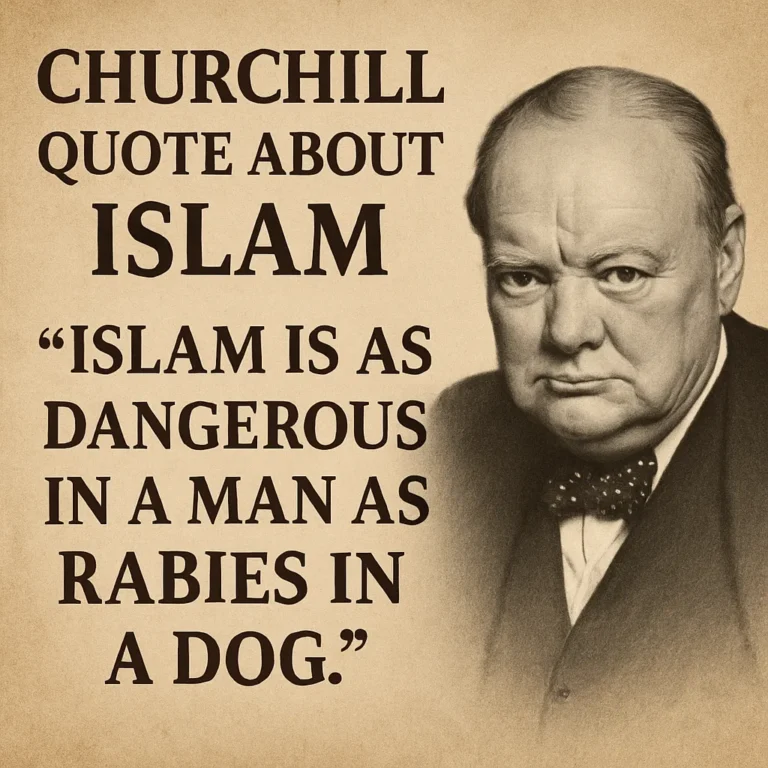
Introduction: Why a Churchill Quote About Islam Demands Careful Analysis
The figure of Winston Churchill looms large in contemporary debates about empire, religion, and political rhetoric. When a quotation appears that ties the name of Churchill to a reflection on Islam, it instantly becomes a flashpoint for discussions about historical context, authorial intention, and the ethical weight of words in public discourse. This article offers an in-depth analysis of a widely cited Churchill line that engages with Islam in a blunt, provocative register. The goal is not to take a single sentence as the entire record of a complex life, but to situate the quote within its origins, to examine the controversies surrounding attribution and interpretation, and to consider the impact such wording has had—both in its own era and in modern conversations about religion, war, and identity.
Throughout this discussion, we will encounter questions about terminology (for example, the use of Mohammedanism versus Islam), about the historical moment in which Churchill wrote, and about how subsequent readers project meaning onto a sentence that was born in a particular political and military situation. By examining both primary sources and scholarly perspectives, we can gain a more nuanced understanding of how a single quotation travels through time, enters public memory, and becomes a touchstone for debates about religion and power.
Churchill’s Quote About Islam: The Primary Text
The Direct Word: The River War and the Language of the Moment
The most frequently cited direct quotation linked to Churchill and Islam comes from his 1899 work, The River War, in which he writes about the campaigns in Sudan and the Mahdist uprising. The line often reproduced in collections is:
“How dreadful are the curses which Mohammedanism lays on its votaries!”
This sentence appears in a historical narrative that reflects the colonial mindset of its era. The phrasing uses the now-archaic term Mohammedanism, a designation that was common in late 19th-century English prose but is generally avoided today in favor of Islam and related terms. The sentiment is a pointed critique of what the author portrays as the spiritual and social dynamics of the religion in the context of warfare and imperial policy.
Context matters here: Churchill is writing within a memoir-like historical account of military campaigns, not issuing a universal verdict on a faith. Yet the emotional energy of the line—the sense of a religious system casting a curse, a judgment about the consequences of belief—has made it memorable and controversial in equal measure.
Historical Context: The River War, the Mahdist War, and the British Empire
To grasp why such language appeared, it helps to situate the quote within the broader arc of late Victorian imperialism and the military encounters between Britain and Islamist-inspired movements in Africa and the Middle East. The River War recounts the British expedition against the Mahdist State in the Sudan, a period marked by brutal fighting, political rhetoric about civilization and barbarism, and competing visions of religious and cultural legitimacy.
In this milieu, religion and politics are intertwined: the defense of empire often overlapped with the defense of Christian or Western norms, while adversaries invoked religious rhetoric of their own. Against this backdrop, a sentence alleging a curses or misfortune stemming from a religious system functions not only as a literary device but as a way of making a moral and political point about obedience, rebellion, and the effects of faith on society.
Terminology and Tone: The Legacy of the Word Mohammedanism
The term Mohammedanism appears in the quote and in related discussions with similar wording. It reflects a historical vocabulary that identified a religion through the personal name of its founder. In modern usage, Islam is the standard term, with nuanced distinctions among sunnism, shia, sufism, and other currents within the faith. The shift in terminology is not merely cosmetic; it signals changes in scholarly consensus, cultural sensitivity, and the ethical weight of language when discussing religion in public life.
A careful reading asks: Does the original phrase reflect a theological critique of Islam as a faith system, or does it express a broader critique of political movements associated with Islam during a colonial war? The answer matters for how we assess the line today: as a historical artifact, as rhetoric aimed at a particular audience, or as a living statement that continues to shape debates about religion and power.
Limitations and Cautions for Modern Readers
When modern readers encounter this quote, it is essential to distinguish between:
authentic text (the sentence as it appears in The River War, with its central claim about a religious system)
historical context (the war, the political objectives, and the imperial framework within which the sentence was produced)
interpretive lens (how later audiences interpret or repurpose the line for contemporary debates)
These distinctions help prevent anachronistic readings that reframe Churchill’s rhetoric in ways that misrepresent the historical moment or erase the complexity of the author’s position. Bold terms in this section should alert readers to the important ideas at stake: history, language, ethics, and responsibility in quotation and citation.
Contextualizing the Controversy: Attribution, Authenticity, and Interpretation
Authenticity and Scholarly Scrutiny
In the study of historical quotations, attribution accuracy is a central concern. The line from The River War is widely cited, but as with many famous quotations, questions can arise about verbatim accuracy, placement within the original text, and even whether a modern paraphrase from a secondary source accurately reflects Churchill’s own wording.
Scholarly analysis emphasizes checking primary texts when possible and assessing the purpose and audience of the sentence. In Churchill’s case, his writings often blend memoir, reportage, and moral commentary—each mode affecting how readers interpret his judgments about religion, war, and civilization.
Misattribution in Modern Media
In the digital age, quotations can travel widely through social media, blogs, and refashioned encyclopedias, sometimes detached from their historical anchors. A number of online lists and compilations attribute lines about Islam to Churchill that are not supported by the best archival evidence. This pattern does not merely concern academic precision; it also shapes how people understand Churchill’s beliefs and how readers judge him in ethical terms.
When evaluating such material, it helps to adopt a cautious approach: verify against the primary source, note the context in which the sentence appeared, and distinguish clearly between direct quotations and paraphrase or summary.
Ethical Considerations: The Impact of Language about Religion
The wording of a quotation about religion can reinforce or challenge stereotypes. Even when a sentence is historically grounded, readers may react to its tone (condemnatory, accusatory, or animated) and to the use of metaphors like curses or blessings. This is especially true for discussions involving Islam, a faith with a long history and diverse lived experiences across continents.
A rigorous analysis typically pairs close reading of the text with a broader survey of how Britain’s imperial project intersected with understandings of religious difference. This approach helps prevent a single sentence from becoming a stand-in for entire beliefs or communities.
Impact and Legacy: How a Churchill Quote About Islam Has Shaped Discourse
Historical Repercussions in Public Memory
The quote has circulated as a symbol of a certain kind of war-time rhetoric—one that blends moral sentiment with a martial narrative. In historiography and public memory, it is often cited as an example of how religion and war can be entangled in political rhetoric. For readers and scholars, the line raises enduring questions about:
How religious ideas are used to justify political or military actions
Whether harsh language toward a religious tradition is a defect of the speaker or a symptom of a broader historical moment
How readers interpret controversial statements when they are embedded in historical narratives
Contemporary Receptions: From Debates over Islam to Debates over Language
In modern discourse, passages like Churchill’s line are frequently invoked in arguments about Islamophobia, postcolonial criticism, and the ethics of empire. Critics may see the quotation as a cautionary example of how empire-era rhetoric could dehumanize religious groups, while supporters of traditional views might defend the sentence as a historical artifact that reflects a particular standpoint rather than a universal judgment.
The impact of the quote therefore depends not only on what Churchill wrote, but on the interpretive frame through which readers approach it. Some readers see it as evidence of a dismissive attitude toward Islam in the imperial era; others view it as a data point in a broader discourse about how religious identity intersected with geopolitical conflict. In either interpretation, the passage invites readers to reflect on how language reappears, evolves, and catalyzes new debates in different eras.
Scholarly Perspectives on the Quote’s Significance
Several historians and scholars have approached the line as a case study in the politics of quotation, the ethics of description in war writing, and the reception of religion in public life. Their insights highlight that:
Historical sentences are not isolated facts; they are cultural artifacts that reflect the values and prejudices of their authors and their audiences.
Language matters: the terminology used to describe religious communities can either humanize or dehumanize those communities.
Interpretive frameworks such as colonial gaze or postcolonial critique help us understand how power structures shape the production and reception of quotes.
Variations of Churchill Quote About Islam: Semantic breadth and Depth
Direct Citation and Authorized Paraphrase
The core idea of the Churchill line can be framed in a few semantically related forms, each with different rhetorical implications. The following items are presented to illustrate how the sentiment can be expressed while acknowledging the distinctions between citation, paraphrase, and interpretation.
Direct quote (verifiable): “How dreadful are the curses which Mohammedanism lays on its votaries!” — from The River War (1899).
Paraphrase aligned with Churchill’s critical stance: A sentence expressing that certain religious movements can unleash harsh consequences upon their followers, especially in the context of conflict. (Note: this is a paraphrase, not a new verbatim quotation.)
Historical paraphrase for modern readers: In the colonial narrative, some critics describe the line as an indictment of how religious zeal can accompany political coercion and violence.
Paraphrase Variants (clearly labeled as paraphrase)
The following variations are paraphrastic restatements designed to capture the sentiment without duplicating the exact wording:
Paraphrase A: The religion in question imposes burdens and curses on those who follow it, especially in the crucible of war.
Paraphrase B: The belief system associated with Mohammed—old terms aside—seems to bring a heavy price for its adherents in times of conflict.
Paraphrase C: In the context of imperial warfare, the creed described as Islam by its critics was portrayed as having consequences that spurred spiritual and social curses upon its devotees.
These paraphrases are not attributed as direct quotations to Churchill but are offered as semantic variants that illuminate how readers might rephrase a historically situated critique of religion during war.
Contemporary Reframing: Variants Used in Public Debate (Non-Attribution)
In contemporary debates, writers often recast the idea into more generalized, non-attributed formulations to avoid endorsing a harsh view. Examples include:
Variant 1: Some critics argue that religious dogma can become a weapon in political struggles, influencing people to see curses where others see guidance.
Variant 2: The rhetoric surrounding religious movements can be severe, especially in times of war, and such language risks hardening into prejudice.
Variant 3: An intellectual tradition has warned about how religious extremism can cause harm to communities, even as it seeks to protect its own identity.
Analytical Takeaways: How Variations Shape Meaning
Using a direct quote versus paraphrase changes tone, authority, and interpretive burden on the reader. A direct quotation anchors the claim in a specific historical moment and author, inviting readers to judge the rhetoric as a cultural artifact. Paraphrases and modern reframings shift the emphasis toward ethics and critical reflection on the dangers of religious language in war, inviting more cautious engagement with the past.
Conclusion: Reflections on Context, Controversy, and Impact
Putting a Single Sentence in a Broader Frame
An extensive analysis of Churchill’s line about Islam shows that a sentence can function as a window into a particular era while also serving as a mirror for present-day concerns. The quote invites readers to interrogate how religion, war, and power intersect in public discourse, and it tests our ability to read words critically without passing immediate judgment on a living tradition.
From this case study emerge several important takeaways:
Historical literacy matters: understanding where a sentence came from helps prevent distortions in interpretation.
Ethical language matters: the words we choose to describe religion in conflict can either dehumanize or humanize communities.
Critical reception matters: how readers interpret a quote depends on the frameworks they bring—be it postcolonial theory, historical analysis, or ethical reflection.
Contextual nuance matters: a sentence in a military history book has a different weight than a slogan in modern political discourse.
Final Thoughts: How to Read Churchill, Islam, and History
In closing, this discussion emphasizes responsible reading and historical curiosity. We should approach Churchill’s line not as a definitive verdict on Islam but as a historical text that reveals the tensions of its time. By recognizing its limits, acknowledging its disciplinary context, and paying attention to how language shapes perception, we contribute to a more nuanced conversation about religion, empire, and responsibility in public life.