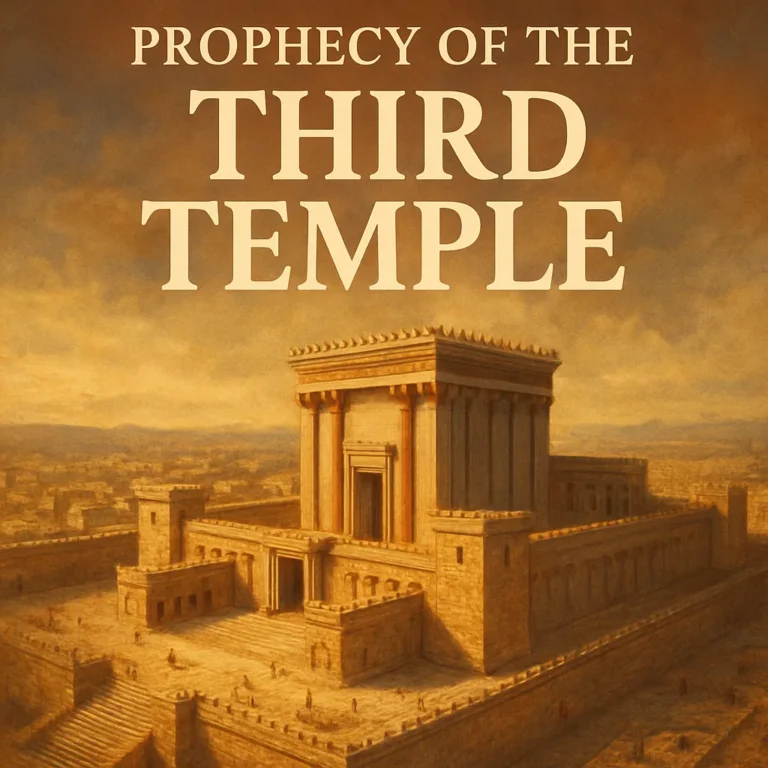
Origins and Early Echoes: Tracing the Seedbed of the Prophecy of the Third Temple
The idea often framed today as the prophecy of the Third Temple is not a single medieval spell or a single verse pulled from a lone prophet. It is a layered set of expectations that develops over centuries at the intersection of biblical memory, apocalyptic literature, and evolving religious imagination. In broad terms, the memory of two successive sanctuaries—the First Temple built under Solomon and the Second Temple rebuilt after the Exile—provides the historical frame. The longing for a future sanctuary, a sacred space in which the divine presence would once again dwell among a community, becomes a recurring thread in Jewish thought, later refracted through Christian eschatology and certain Islamic and secular reformulations. The phrase itself—the prophecy of the Third Temple—emerges from later Jewish and Christian writers who envision a rebuilt temple as a prerequisite or symbol of messianic fulfillment.
In the biblical arc, the story of temples is central to the memory of Israel. The First Temple era (Solomon’s Temple) collapses in 586 BCE, prompting exile and crystallizing the longing for a house of worship that would re-center the covenantal relationship. The Second Temple period (begun by Zerubbabel and later expanded by Herod) stands for a time of renewed worship, sacrifice, and national aspiration, even as it becomes a stage for political fragility and spiritual contest. The idea of a future temple—whether in prophetic visions or in the messianic imagination—persists when the historical temple system is broken or displaced. In this sense, the Third Temple prophecy is not a single declaration but a spectrum of expectations that recast temple service, ritual purity, and divine presence for later generations.
As scholars trace the prophecy for the Third Temple, several sources loom large. The climactic visions in the book of Ezekiel, especially chapters that describe a future, grand temple and a new order of sacrifice, become the most cited scriptural anchor. The prophets’ language about a house of prayer for all nations, the universal peace of the land, and the reconfiguration of sacred space are reinterpreted across centuries. In later rabbinic literature, the idea of a future sanctuary is integrated with messianic expectations, ritual law, and the eschatological calendar. In the Christian tradition, these expectations are sometimes harmonized with the coming of Christ and the advent of a new covenant, while other streams emphasize the restoration of the temple as a sign preceding or accompanying end-times events. The result is a diversified tapestry: prophecies about the Third Temple become a common motif in debates about the destiny of Jerusalem, sacred space, and divine sovereignty.
Classical and Rabbinic Perspectives on a Future Sanctuary
From Exile to Eschatology: Temple Thought in Early Judaism
The memory of the First Temple and the Second Temple shapes how later generations imagine a time when the divine presence would dwell among people again in a restored sanctuary. In many strands of rabbinic thought, the end-times temple is less a precise blueprint than a symbol of restoration: a restored relationship with God, a reordering of priestly life, and a universal invitation to the nations to come and learn righteous governance. The language of the emph{Third Temple} begins to rise in intensity as the Second Temple era wanes and the Jewish people endure diaspora life, charting a future in which the temple’s rededication would illuminate the path of redemption.
Temple service and ritual purity as core motifs reappear, but with the understanding that a future sanctuary may need to be reinterpreted or reestablished in light of new political, social, and ethical realities.
The notion of a single, indispensable sanctuary is balanced by a growing sense that the divine presence can be encountered in multiple ways, yet the longing for a future physical house remains potent.
In some strands, the idea of a yet-unrealized temple coexists with a more metaphorical understanding of temple (“the temple of God” as a people or as the soul). This dynamic helps explain why discussions of the Third Temple prophecy appear in both liturgical poetry and critical polemics.
Rabbinic Literature and Messianic Expectation
In rabbinic circles, the future temple becomes a touchstone for messianic hope. The Babylonian Talmud and later Midrashim frequently engage with questions about the timing, feasibility, and ethical implications of rebuilding a sanctuary. While the rabbinic world would not possess a single treaty about a “Third Temple” in the way a modern reader might expect, it develops a robust discourse about the end of exile, the restoration of sovereignty, and the re-emergence of the sacrificial system when appropriate divine conditions are fulfilled. The prophecy of the Third Temple in this era is thus embedded in a broader conversation about repentance, justice, and the political realities of living in exile or in a homeland with competing powers.
Christian and Islamic Readings: Variations on a Shared Theme
Christian Eschatology and the Temple Motif
In Christian thought, the temple motif often intersects with ideas about Christ, the covenant, and the last days. For some Christian interpreters, a future physical temple in Jerusalem is a sign that certain prophetic timelines are converging, while others understand the prophecies more metaphorically—signifying the church as a living temple or the believer’s body as the dwelling place of the divine Spirit. The language of a Third Temple appears as a symbol of renewal, judgment, and divine sovereignty in various apocalyptic landscapes. Debates persist about whether the fulfillment of these prophecies is primarily ethical, geopolitical, or spiritual, and whether a rebuilt sanctuary would serve as a catalyst for peace or a flashpoint for conflict.
Islamic Perspectives on Jerusalem and the Sacred Space
In Islamic tradition, Jerusalem is home to important sacred sites, and the fate of the Temple Mount is tightly bound to questions of sovereignty, reverence, and future expectation. While Islam does not anticipate a rebuilt Jewish Third Temple in a way that mirrors Jewish or Christian speculations, the issue remains central to discussions of prophetic signs and end-time narratives in some modern Islamic eschatologies. In this context, the Temple Mount becomes a stage upon which competing visions of the sacred past and future are negotiated, with implications for interfaith relations and regional politics. The modern discussion of the prophecy for the Third Temple often intersects with questions about access, custodianship, and the legal frameworks governing holy sites.
Modern Movements and Institutions Claiming the Legacy
The Temple Institute and Contemporary Reconstruction Ambitions
Since the late 20th century, a number of groups have grown out of Jewish religious reform and Zionist revival that actively engage with the idea of preparing for a future sanctuary. The most well-known is the Temple Institute in Jerusalem, which has pursued practical and symbolic projects inspired by the prophecy of the Third Temple to keep the memory and the ritual imagination alive. These initiatives include:
Architectural designs and model blueprints for the Holy Temple services, drawing on ancient sources to imagine a plausible structure and order of worship.
Ritual implements such as a ceremonial menorah, silver trumpets, and ritual vessels that would be used in a future temple service.
The controversial issue of a purified priesthood and the complex, long-standing debate about how—if ever—the sacrificial system could be restored in a modern context.
While these efforts are symbolic and educational rather than immediate political action, they contribute to a broader cultural memory: the dream of a future sanctuary remains a living component of religious identity for many adherents. The presence of such institutions shows how the prophecy for the Third Temple continues to shape contemporary religious life, public discourse, and the cultural geography of Jerusalem.
Educational and Messianic Communities
Beyond the Temple Institute, a range of educational programs, religious schools, and messianic circles keep the topic vibrant. These communities often link eschatological timing with moral and ethical renewal, urging adherents to study the law, perform acts of charity, and nurture a hopeful, peace-seeking stance within their broader social environment. The modern conversation about the Third Temple prophecy thus travels through classrooms, lecture halls, and house churches as much as through political debates.
Political, Social, and Ethical Dimensions in the Contemporary World
Jerusalem, Sovereignty, and Sacred Space
The idea of a future sanctuary sits at a particularly sensitive intersection in the late modern world. The Temple Mount is one of the most contested religious spaces on the planet, a site that holds profound significance for Jews, Muslims, and Christians alike. The prospect of rebuilding or re-establishing a temple there carries heavy political implications: it touches questions of sovereignty, governance, and the possibility of interfaith coexistence or renewed conflict. Proponents of a rebuilt sanctuary often emphasize peace, religious freedom, and fulfillment of prophecy, while critics warn of destabilization, religious exclusivity, and the risk of inflaming sectarian tensions. The ongoing dialogue about the prophecy of the Third Temple in this setting must weigh historical memory against current realities and the urgent need for coexistence.
Ethical Reflections: Ritual, Memory, and Public Life
The modern discourse around a potential temple is not merely about architecture or ritual practice. It engages with deeper questions: what does sacred space mean in a pluralistic society? How should ancient rituals be reinterpreted in the service of universal ethics? Can a symbol of divine presence be reconciled with a political order that seeks equal rights and religious freedom for all citizens? These questions force a sober reckoning with the idea that prophecy, in any form, is not only about foresight but also about responsibility—how communities act in the present to honor their past while safeguarding the dignity and rights of others who share the same land.
Interpretive Variations: How the Prophecy of the Third Temple Has Been Framed
Across traditions and eras, the notion of a future temple has been read in multiple ways. Some frameworks emphasize a literal reconstruction of a physical building as the central signal of fulfillment. Others view the temple as a symbolic architecture—the faith community itself becomes the temple, or the temple’s divine presence is perceived as residing in acts of justice, charity, and communal worship. A third approach treats the concept as an ongoing historical driver—a metaphor for renewal, repentance, and the reordering of society toward divine ideals. Whatever the interpretive path, the dominant thread is a persistent belief that space, ritual, and sacred time can converge in the eschatological horizon.
Literalist readings in which a rebuilt Temple on a physical site is anticipated as a concrete event in history.
Symbolic or spiritual readings that recall the temple’s presence through ethical living, communal worship, and spiritual transformation.
Interfaith and peace-oriented interpretations that harness the imagery of a future sanctuary to promote dialogue, mutual respect, and shared stewardship of sacred spaces.
Historical Continuities and Contemporary Relevance
The prophecy of the Third Temple is not simply a relic of ancient hope. It has continuity into the present through literature, education, and religious practice. The modern revival of temple-related discourse intersects with national memory, religious identity, and a broader discussion about how communities imagine their future. For some, the idea remains a catalyst for national renewal and spiritual reformation; for others, it is a reminder of the fragility of religious harmony and the need for steadfast commitment to human dignity and civil peace. Across all these currents, the topic remains a powerful lens on how sacred history informs present choices.
Alternative Expressions and Semantic Breadth
To deepen understanding, it helps to encounter variations of the phrase that convey nuance while maintaining core meaning. These phrases reflect different emphases, times, and communities while pointing toward a shared horizon:
Prophecy of a future sanctuary
Vision of the Third Sanctuary
Messianic temple expectation
Future temple theology
Temple restoration hope
Judaism and the coming sanctuary
Each variation opens a distinct doorway into how people imagine divine presence, ritual life, and the political-ethical order in a futuretime. The diversity of language reflects diverse communities, each carrying forward the memory of the ancient sanctuaries and the enduring question: what kind of future can a rebuilt sanctuary imply for justice, peace, and shared humanity?
Concluding Reflections: The Modern Significance and the Possible Futures of the Third Temple Narrative
The prophecy of the Third Temple remains one of the most enduring and contested images in religious history. Its origins lie in the deep memory of a fractured past—the loss of the First and Second Temples—and in the persistent dream of a sacred space where divine presence would be manifest among people. Its modern significance lies not only in religious devotion but in how societies negotiate sacred space amid democratic pluralism, international diplomacy, and interfaith relations. The conversation about a prospective sanctuary—whether imagined as literal architecture, spiritual embodiment, or ethical aspiration—continues to shape debates about Jerusalem, sovereignty, and the kind of future the world seeks to build.
In a plural global context, the enduring lesson may be this: the prophecy of the Third Temple invites a careful balance between historical memory and contemporary responsibility. It challenges communities to honor the past while protecting the rights of all who share sacred spaces. It invites scholars, believers, policymakers, and citizens to consider how sacred narratives can inspire peaceful coexistence, mutual respect, and a common commitment to human flourishing. Whether one reads it as a literal blueprint or as a rich metaphor for renewal, the third-temple conversation remains a powerful test case for how civilizations translate ancient dreams into ethical action in the present day.