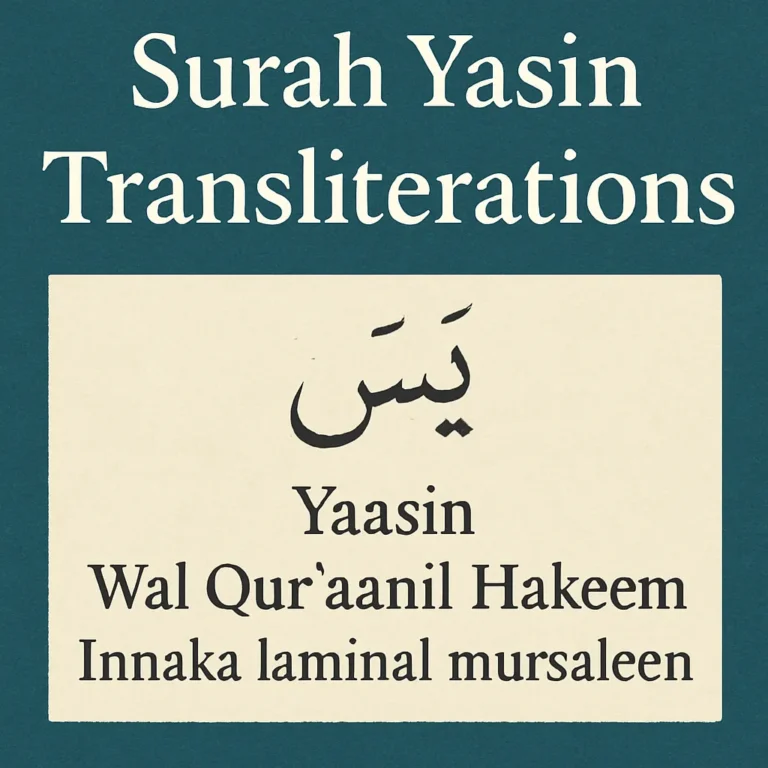
Introduction: Surah Yasin and the Purpose of Transliteration
Surah Ya-Sīn (Arabic: سُورَةُ يَسِينَ) is widely revered within the Qur’anic tradition for its themes of faith, guidance, and the humbling reminder of mortality. For learners and readers who are not fluent in Arabic script, transliteration provides a bridge between the beauty of the original text and the practical goal of accurate pronunciation. This article focuses on the pronunciation guide, the transliteration chart, and available audio resources to support learners at different stages. It uses variations of transliteration to reflect real-world practice, where publishers, scholars, and teachers may adopt slightly different spellings while preserving the sounds of the original Arabic.
Transliteration is not a substitute for translation or for studying the rules of Tajweed. Rather, it is a bridge that helps non-Arabic speakers approximate the sounds of the letters, diacritics, and pauses, enabling a smoother and more confident recitation. In this article you will encounter several transliteration styles, each with its own strengths: diacritics that mark long vowels, consonant doubling, and hamza indications. We will also provide guidance on how to read the harakat—the short vowels and other marks that shape the rhythm of the verses.
Pronunciation Guide: Foundations for Reading Surah Yasin
Before diving into transliteration charts, it helps to ground yourself in a few basic concepts of pronunciation that recur across the Surah Yasin and other surahs. The following guide highlights practical tips for approaching the text with a near-native cadence.
Key Arabic sounds you will encounter
Harakat (short vowels): Fatḥah (a), ḍammah (u), Kasrah (i).
Long vowels: Alif (ā), Wāw (ū), Yā’ (ī) extend the sound of the corresponding short vowel.
Hamzah: The glottal stop, often written in transliteration as ‘ or indicating breaks in the word (for example, in ar-Raḥmāni).
Madd and elongation: Some vowels are lengthened, marked by a macron (ā, ī, ū) in many transliteration schemes, to indicate longer articulation.
Shaddah (doubling of a consonant): Doubles the consonant and affects the rhythm of recitation.
Sukūn (no vowel): A consonant occurs without a following vowel; this pauses the recitation or invites a breath pause.
Reading tips for accurate pronunciation
Listen first: Pair any transliteration with listening to a well-known reciter to match the sounds and cadence.
Practice with pauses: Rehearse with deliberate pauses at pauses or punctuation marks to emulate the natural flow.
Emphasize the long vowels: Distinguish between short and long vowels to avoid mispronunciations that alter meaning.
Mind the glottal stop: Pay attention to hamza placements; misplacing hamza can distort the intended phonetic break.
Use a consistent transliteration style: When practicing, stick to one transliteration system in a session to reinforce learning, and then compare alternatives later.
Common transliteration cues in Surah Yasin
Ya-Sīn often appears with a macron on the a and i vowels in certain schemes: Yā-Sīn or Ya-Sīn (depending on whether long vowels are marked).
Names like Rāḥman and Rāḥīm show long a sounds and a strong emphasis on the final -m in some verses, which is important for pronunciation and rhythm.
Two words beginning with ar- (for example, ar-Raḥmāni and ar-Raḥīm) illustrate the assimilation of ال (the definite article) into the sounds of the next word in many recitation styles.
Transliteration Variants: How transliterations differ and why
Transliteration is a practical tool, but there is no single universally agreed standard for rendering Arabic into Latin script. In religious and academic contexts, several widely used systems exist. Each system has its own rules for representing long vowels, diacritical marks, emphatic consonants, and anglicized spellings. The following sections describe several major transliteration schemes you will encounter when studying Surah Yasin, with examples to help you compare and contrast.
Overview of major transliteration schemes
ALA-LC Romanization: A scholarly standard commonly used by libraries and linguists. It uses diacritics to mark long vowels and some emphatic consonants (for example, ā, ḥ for ḥa). It aims for precision and is widely cited in academic works.
ISO 233-2: An international standard with clear rules for long vowels and consonant quality. It also employs diacritics to distinguish sounds such as ā and ḥ.
DIN 31635: A German standard used in academic contexts, incorporating diacritical marks similar to ISO and ALA-LC to preserve phonetic detail.
Plain ASCII / Basic Latin (no diacritics): A practical approach for digital text without diacritics, using aa, ih, or u to approximate long vowels, and often sacrificing some precision for readability.
Diacritic-rich or diacritic-inclusive variants: Some publishers add diacritics more liberally to indicate vowel length and emphatic sounds, which can help novices, but may differ from one publisher to another.
First verse transliteration in several schemes: a practical reference
The opening verse of Surah Ya-Sīn is commonly rendered as the following in different styles. Note that the exact rendering may vary slightly among publishers, but the core sounds remain the same.
ALA-LC style: Bismi llāhi r-raḥmāni r-raḥīm
ISO 233-2 style: Bismi-l-lāhi ar-raḥmāni ar-raḥīm
DIN 31635 style: Bismi l-Lāhi ar-Raḥmāni ar-Raḥīm (diacritical marks may vary slightly by edition)
The definite article al- in Arabic often combines with the following word. Depending on the transliteration scheme, you may see llāhi or l-Lāhi, with the extra l representing assimilation (elision) of al- in some renderings.
The long vowels are typically shown as ā, ī, ū in macron-based schemes, while plain ASCII renders them as aa, ii, uu or simply a, i, u depending on the publication.
Consonant quality such as ḥ (ḥā) and ṭ vs t, or q vs k is preserved in many scholarly schemes to reflect the original phonology, while more casual transliterations may shorten or simplify these values.
Transliteration Chart: Key Letters, Sounds, and How They Are Rendered
The following chart-style guidance helps you map common Arabic letters and features to their transliterated equivalents across typical schemes. This section emphasizes practical understanding rather than providing exhaustive scheme-specific spellings. It is designed to support learners who are assembling transliterations for Surah Yasin or similar texts.
Vowels and diacritics: a quick reference
Fatḥah (َ) → a
Ḍammah (ُ) → u
Kasrah (ِ) → i
Long vowels → ā, ū, ī (macrons often used in scholarly transliterations)
Hamza (ء) → ‘ or an apostrophe near the letter
Ḥamzah-tanween and other diacritics → additional markings in some schemes to indicate stops or nasalization
Consonants: common renderings and their variants
ب (Ba) → b
ت (Ta) → t
ث (Tha) → th or ṯ in some schemes
ج (Jim) → j
ح (Ḥa) → ḥ (emphatic h)
خ (Kha) → kh or x
د (Dal) → d
ذ (Dhal) → dh
ر (Ra) → r
ز (Zay) → z
س (Seen) → s
ش (Sheen) → sh
ص (Sad) → s or ṣ (emphatic)
ض (Dad) → D or ḍ
ط (Ta) → T or ṭ
ظ (Dha) → z or ẓ
ع (Ain) → ʿ (awned glottal stop; often written as `)
غ (Ghain) → gh
ف (Fa) → f
ق (Qaf) → q or k in some casual renderings
ك (Kaf) → k
ل (Lam) → l
م (Meem) → m
ن (Noon) → n
هـ (He) → h or H
و (Waw) → w or ū when used as a long vowel in some contexts
Transliteration Chart: Example Drill with Surah Ya-Sīn Phrases
The following drill illustrates how the same phrase might be rendered under several transliteration schemes. This is not exhaustive, but it demonstrates the practical differences you may encounter. The focus is on Ya-Sīn and a few recurring phrases in this Surah.
ALA-LC: Ya-Sīn (for the proper noun) and bi-smi-llāhi for “in the name of Allah”
ISO 233-2: Ya-Sīn, bi-smi-l-lāhi
DIN 31635: Ya-Sīn, bi-smī Allāhi
Phrase 2 (Rāḥmāni and Rāḥīm):
ALA-LC: ar-Raḥmāni, ar-Raḥīm
ISO 233-2: ar-Raḥmāni, ar-Raḥīm
DIN 31635: ar-Raḥmāni, ar-Raḥīm
Phrase 3 (Allah’s names and attributes):
ALA-LC: Allāhu (Allah), ar-Raḥmān, ar-Raḥīm
ISO 233-2: Allah, ar-Raḥmāni, ar-Raḥīm
DIN 31635: Allāhu, ar-Raḥmāni, ar-Raḥīm
Audio Resources: Listening to Surah Ya-Sīn for Pronunciation Practice
Audio is a powerful companion to transliteration, offering a model of accurate pronunciation, rhythm, and tone. In this section you will find guidance on using audio effectively, plus embedded example players for practice. The speakers listed below are well-known reciters, whose renditions can be used to compare phonetic details and cadence with your own transliteration attempts.
Guidelines for using audio in your transliteration practice
Choose a reciter with clear enunciation and a recitation style you enjoy. This can help you stay motivated and focused on accurate pronunciation.
Play slowly at first and pause after each verse to repeat it aloud, comparing your pronunciation against the audio.
Match cadences with breath—notice how pauses align with punctuation and end-of-verse markers.
Supplement with written transliteration and then gradually reduce reliance on transliteration as you become more confident with the sounds.
Recommended audio sources and example players
Reciter: Mishary Rashid Al-Afasy — high-quality studio recitation with clear articulation.
Reciter: Abdul Rahman Al-Sudais — a widely known rendition with a melodic cadence.
Reciter: Saad Al-Ghamdi — often praised for its balance between rhythm and clarity.
The combination of transliteration practice and auditory input is particularly effective for learners who wish to internalize pronunciation patterns and rhythm. Here are some structured steps you can follow to maximize your progress.
Step-by-step practice plan
Step 1: Read with transliteration for a block of verses (e.g., 2–4 verses) while listening to a chosen recitation. Repeat aloud, focusing on matching the sounds you hear with the transliterated text.
Step 2: Isolate tricky sounds (such as the emphatic consonants ḥ, ḍ, ṣ, ṭ, or the glottal stop hamzah) and practice them in short phrases before integrating them into longer phrases.
Step 3: Practice long vowels by emphasizing the macrons used in diacritic-rich transliterations. Repeat until the difference between ā and a is distinctly audible.
Step 4: Compare variants after several practice sessions. Read a verse using ALA-LC, then switch to ISO 233-2 or DIN 31635 and compare how each represents the same sounds.
Step 5: Build a personal glossary of frequently appearing words in Ya-Sīn, noting their transliterated forms, phonetic tips, and common pronunciation pitfalls.
Transliteration in Context: Why Variation Matters and How to Use It
With multiple standards in use, learners may encounter slight differences in how words appear in transliteration across editions. This is not a failure of consistency; rather, it reflects the diverse scholarly and educational ecosystems that publish Qur’anic texts. By understanding the purpose of each transliteration style, you can:
Respect scholarly precision by aligning your practice with ALA-LC or DIN 31635 when studying academically.
Maintain readability by using plain ASCII transliteration in casual notes or digital environments where diacritics are inconvenient.
Enhance comprehension by cross-referencing two or more transliterations to capture subtle phonetic cues that might be missed by a single system.
Audio and Transcript Alignment: Using Sound to Improve Accuracy
One effective approach is to align a transliteration line by line with a corresponding transcript and an audio clip. This aligned practice can improve both pronunciation and timing.
How to create your own aligned practice set
Choose a short excerpt from Ya-Sīn, such as a sequence of 3–5 verses.
Obtain an authoritative audio recording of the same excerpt from a reputable reciter.
Type or paste a transliteration line for each verse, selecting one of the transliteration schemes you prefer.
Play the audio while reading the transliteration aloud in sync with the cadence. Pause after each verse to review how closely your pronunciation matches the audio.
Common Pitfalls and How to Overcome Them
Overlooking hamza placement: The presence or absence of a hamza can change the syllabic structure of a word. Double-check hamza locations, especially in words like ar-Raḥmāni and ar-Raḥīm.
Confusing long and short vowels: The difference between ā and a is subtle but meaningful in meaning and cadence. Practice with macrons, then transition to plain text once the sound is internalized.
Inconsistent transliteration styles: When practicing, select one style per study session; switch styles only after you have built a basic comfort with the sounds.
Rushing through verses: Ya-Sīn is notable for its pauses and rhythm. Try to recite slowly at first, then gradually speed up as you gain confidence.
Glossary: Key Terms Used in Transliteration and Pronunciation
Ya-Sīn: The name of Surah Ya-Sīn, often transliterated with a long a and long i sounds in certain schemes.
Ya, Sin (letters ي and س)
Harakat: The short vowels and marks that guide pronunciation.
Macron: A horizontal line above a letter (e.g., ā) indicating a long vowel.
Ghunna: A nasalization that often occurs in certain recitation patterns and transliteration notations.
Tajweed: The correct pronunciation rules for Qur’anic recitation, often taught alongside transliteration to reinforce accuracy.
Conclusion: Using Transliteration, Chart, and Audio as a Comprehensive Toolkit
The transliteration of Surah Ya-Sīn—together with a robust pronunciation guide and an audio resource—offers a practical, layered approach to Qur’anic study for non-Arabic readers. By engaging with multiple transliteration schemes, you gain a more flexible understanding of how sounds can be represented in Latin script. Pairing transliteration with listening practice helps refine pronunciation, rhythm, and confidence in recitation.
Remember that transliteration is a tool for learning, not the final destination. As your comfort with the sounds grows, gradually incorporate origial Arabic script alongside a trusted translation to deepen your understanding of meaning and context. The resources and approaches outlined in this article are designed to be adaptable to your personal learning pace and stylistic preferences. May your study of Ya-Sīn be spiritually rewarding and linguistically enriching.