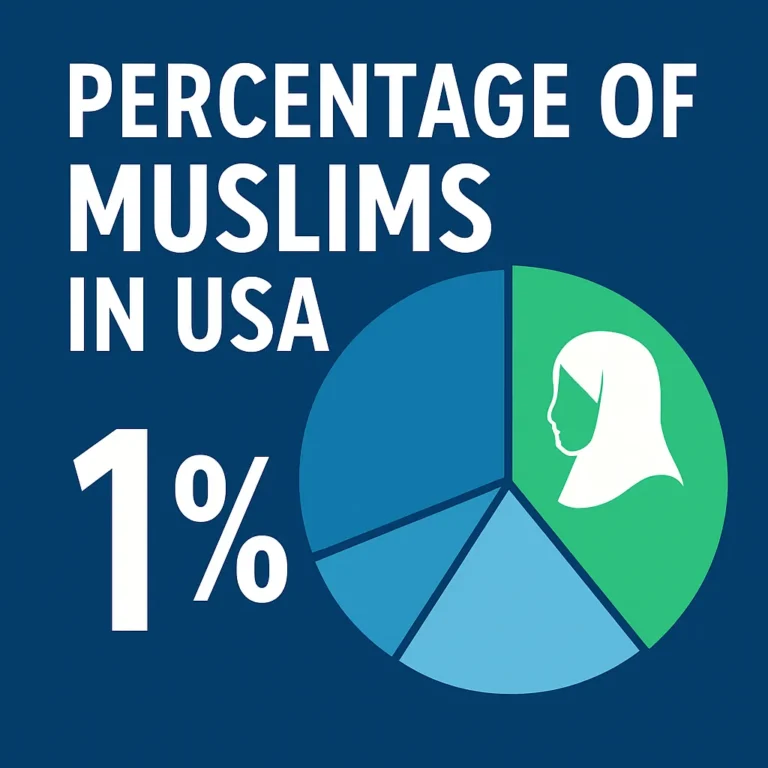
Understanding thepercentage of Muslims in the USA involves combining demographic data, survey methods, and careful interpretation of what counts as Muslim identity. This article explores the Muslim population share in the United States, how researchers measure it, where Muslims live, who they are, how the numbers have changed over time, and what the near-term future might look like. The aim is to provide a detailed, balanced, and data-informed view of Muslim population percentage in the USA that can inform scholars, policymakers, journalists, and readers interested in demographics, religion, and society.
Overview: what does the percentage of Muslims in the United States signify?
At its core, the Muslim population share in the United States is the proportion of people who identify as Muslim or who are adherents of Islam according to a given data source. Because religion and ethnicity interact with immigration status, age, language, and education, the share of Muslims in the U.S. is not a fixed number. It varies by data source, by definitions (self-identification vs. cultural affiliation), and by the timeframe studied. Some common formulations you will encounter include:
the percentage of Muslims in the United States in a given year
the Muslim population share of the overall population
the Muslim population percentage in the USA as reported by major research centers
the share of Muslims among U.S. adults versus among all residents
Across studies and analyses, the global narrative remains consistent in showing that the Muslim population in the United States is a small but growing minority, with growth driven by immigration, higher birth rates in some Muslim communities, and changes in religious identification over generations. The important caveat is that estimates vary and should be interpreted with attention to the underlying methodology.
Data sources and definitions: how researchers measure the percentage of Muslims in the USA
Two primary kinds of sources are used to estimate the Muslim presence in the United States:
Survey-based estimates that ask respondents about religious identity or adherence. These can be conducted by Pew Research Center, public opinion groups, or academic researchers. They typically report the share of Muslims in the U.S. as a percentage of the adult or total population, depending on the survey design.
Demographic estimates that extrapolate from census data, immigration records, and birth rates to model the size of the Muslim population. These estimates often report the Muslim population percentage in the USA as a proportion of the total population, reflecting both recent immigrants and the children of immigrants.
Important methodological notes:
Some surveys measure self-identified Muslims who explicitly say they practice or identify with Islam; others measure Muslim adherence more broadly, including cultural identification.
Some estimates focus on own-label identity, while others include people who report Islam as their religion without necessarily practicing regularly.
Population estimates depend on the denominator (total population in a given year) and the definition of who counts as Muslim (e.g., individuals who practice vs. cultural identification).
Prominent sources often cited in discussions about the percentage of Muslims in the United States include the Pew Research Center and the Association of Religion Data Archives (ARDA). Both provide transparent methods and helpful context for interpreting numbers, including ranges and uncertainty.
Historical context: how the share of Muslims in the USA has evolved
Early presence and waves of immigration
The Muslim presence in North America dates back centuries, but the modern Muslim population in the United States is characterized by several waves of immigration beginning in the late 19th and early 20th centuries. During these periods, immigration from the Middle East, South Asia, and later Africa and Southeast Asia contributed to a small but steady growth in the Muslim community. In historical terms, the percentage of Muslims in the United States was extremely small in the early 20th century, often well under 1% of the population by conventional estimates. The growth trajectory accelerates in the latter half of the 20th century as new communities settle and establish religious and cultural institutions.
By the late 20th century, the Muslim population share in the United States had risen from less than 1% to a clearer, though still modest, minority. In this era, legal immigration policies and family reunification processes contributed to a steady influx of Muslim families from diverse countries. The share of Muslims among adults and the total population began to reflect both immigration and higher birth rates in certain communities, though the overall percentage remained below 2% for many years.
2010s to present
During the 2010s and into the 2020s, the Muslim population percentage in the USA gradually rose as immigration continued and communities grew. Pew Research Center and other studies generally place the percentage of Muslims in the United States in the approximate range of 1.0% to 1.2% of the national population in this period, with the absolute number in the low millions (roughly between 2.8 million and 3.5 million, depending on the year and method). In some projections, the Muslim population share could increase more rapidly if immigration patterns intensify or if birth rates remain higher among Muslim communities compared with some other groups. The key takeaway is that the Muslim population percentage in the USA remains a minority, but it is not static—growth is plausible and has been observed in multiple data series.
Current estimates: what is the share of Muslims in the U.S. population today?
As of the most recent widely cited analyses, the percentage of Muslims in the United States is generally reported as approximately 1% to 1.3% of the total population, though the exact figure depends on the data source and method used. In practical terms, this translates to roughly 3 million people identifying as Muslim or practicing Islam, within a country numbering well over 330 million residents. Several key points help contextualize these numbers:
Relative size: Muslims constitute a small minority, smaller than Catholic, Protestant, or Jewish population shares in the United States, but still a visible and growing presence in cities and universities.
Geographic concentration: A large share of the Muslim population resides in a handful of metropolitan areas and states with historically higher immigrant populations.
Demographic diversity: The community includes people born in the United States and abroad, representing a spectrum of cultural and linguistic backgrounds.
Note a few semantic variations you may encounter when reading about this topic: percentage of Muslims in the United States, Muslim population share in the USA, Muslim population percentage in the USA, share of Muslims in the U.S. Each phrasing highlights the same underlying concept but from slightly different framing perspectives.
Geographic distribution: where in the United States is the share of Muslims the highest?
The regional distribution of Muslims in the United States shows notable concentration in particular metropolitan areas and states. Several patterns emerge:
Urban hubs tend to have higher concentrations of Muslims due to job opportunities, educational institutions, and established immigrant communities. Cities in the Northeast, Midwest, and West Coast often have visible Muslim neighborhoods and well-known mosques.
States with larger immigrant populations—such as California, New York, New Jersey, Michigan, and Texas—tend to have a higher absolute number of Muslims, contributing to a higher population share in those locales.
Suburban and peri-urban areas around major cities also show rising shares as families seek housing and community networks beyond city centers.
In terms of regional shares, you will commonly see that the Muslim population percentage in the USA is elevated in major metropolitan regions, with smaller but meaningful communities in several other states. Regional variation reflects both historical settlement patterns and ongoing demographic change.
Urban vs. rural: how dense are Muslim communities?
Analysts often describe a higher density of Muslim residents in urban counties, with mosques and Islamic centers serving as anchors for communities. In rural areas, Muslim populations exist but are typically less concentrated, which can influence the perceived percentage of Muslims in local contexts. For policy discussions and community planning, it matters to distinguish between urban Muslim density and rural Muslim presence.
Demographic characteristics: who makes up the Muslim population share in the United States?
Understanding the demographic profile of the Muslim population in the United States involves looking at age, birthplace, education, income, and family structure. Here are some key features commonly reported in studies:
Age structure: The Muslim population in the United States tends to be younger on average than the general population, with a larger share in younger age cohorts. This has implications for education, labor markets, and long-term community dynamics.
Birthplace and ancestry: A substantial portion of Muslims in the United States are immigrants or children of immigrants. American-born Muslims and foreign-born Muslims together create a diverse, multi-generational community.
Education: Among Muslim Americans, educational attainment is broadly high, with many completing tertiary education and pursuing professional careers, though there is variation across communities and regions.
Income and occupation: Household income ranges widely, reflecting diversity in occupation, geography, and human capital. Some Muslim communities concentrate in professions such as healthcare, engineering, business, and academia.
Family and religious practice: Family life and religious practice vary widely—from highly observant communities with regular religious activity to more secular or culturally Muslim individuals.
When discussing the Muslim population percentage in the USA or its share among adults, researchers often break down by age cohorts and nativity status to understand future trajectories. The young age profile of many Muslim communities suggests continued growth potential in the coming decades, especially if immigration remains a factor and if natural increase persists.
Age, nativity, and immigration patterns: how do they shape the Muslim population share?
Two intertwined factors help explain ongoing changes in the percentage of Muslims in the United States:
Immigration from Muslim-majority or Muslim-minority countries contributes new adherents and new households, affecting both the numerator (Muslims) and the denominator (total population).
Birth rates within Muslim communities can differ from national averages, contributing to natural increase in some periods. While birth rates vary by country of origin and generational status, this factor can influence the long-term trajectory of the Muslim population share.
Because immigration status and family formation are dynamic, demographers pay close attention to the interplay of births, deaths, immigration, and outbound mobility when projecting future Muslim population percentages in the USA.
Education, language, and socio-economic indicators within the Muslim population share
Education and language proficiency are often correlated with economic outcomes, civic participation, and social integration. Some key observations include:
Educational attainment among Muslim Americans tends to be high in many communities, with significant representation in science, technology, engineering, and mathematics (STEM), healthcare, education, and professional services.
Language diversity is common, with many Muslim Americans speaking English at high proficiency and maintaining heritage languages from their communities of origin.
Socio-economic status ranges widely; some Muslim-majority immigrant families accumulate advances in education and income, while others face barriers related to access, credential recognition, or discrimination.
These dynamics influence not only the percent of Muslims in the U.S. but also the broader social and economic fabric of American cities and neighborhoods. In policy discussions, the Muslim population percentage in the USA is often assessed alongside indicators of social cohesion, civic engagement, and interfaith dialogue.
Comparative context: how does the Muslim share compare to other religious groups?
In the United States, Muslims represent a smaller share of the population than many other religious groups, but their presence is proportionally similar to but distinct from other minority faiths. A few comparative observations:
Muslims vs. other faiths: The Muslim population share is generally smaller than those of Christians (Catholics and Protestants) and Jews, but similar to or larger than some Buddhist, Hindu, or Sikh groups, depending on geographic area.
Regional variation: In some urban areas, the Muslim population percentage in the USA can be more prominent due to clustering with immigrant communities and concentration of mosques and Islamic centers.
Temporal trends: Throughout the 2000s and 2010s, some religious groups grew faster in absolute numbers, while the percentage of Muslims in the United States remained a relatively modest proportion but with signs of gradual increases in certain locales.
These comparative patterns illustrate that, while the percent of Muslims in the United States is a minority, the community is diverse and dynamic, contributing to the evolving religious landscape of the nation.
Geopolitical and social implications of the Muslim population percentage in the USA
Understanding the Muslim population share carries implications for multiple domains:
Public discourse: Discussions about religious freedom, civil rights, and pluralism are often informed by the size and distribution of Muslim communities.
Education and community services: Schools, universities, and community centers respond to the needs of diverse Muslim students and families, which can be tied to regional concentrations of the Muslim population share.
Politics and representation: As the community grows, questions about representation in local and national government, interfaith collaboration, and policy priorities become more salient.
Interfaith and cross-cultural engagement: The presence of a notable Muslim population encourages partnerships across faith communities, helping to shape a more inclusive civil society.
In sum, the percentage of Muslims in the United States is not just a demographic statistic; it intersects with questions of identity, democracy, and social integration in the 21st century.
Methodological notes: limitations and uncertainties in measuring the Muslim population percentage in the USA
All measurements come with caveats. Some of the main limitations relevant to the Muslim population share include:
Self-identification bias: Some individuals may identify as Muslim culturally but not practice regularly, while others may not label themselves as Muslim even if they engage in certain rituals or beliefs.
Nonresponse and sampling bias: Surveys may underrepresent or overrepresent certain communities due to language, trust, or access issues.
Definition of population: The denominator can shift depending on whether researchers count all residents, all adults, or all citizens, which affects the calculated percentage of Muslims in the USA.
Temporal dynamics: Population shares can change rapidly with immigration policy, global events, and demographic shifts, so a single year’s estimate may not capture broader trends.
Despite these limitations, the convergent findings across reputable sources provide a robust picture of the Muslim population percentage in the United States and its trajectory. Analysts typically report ranges and confidence intervals to reflect the inherent uncertainty in estimates.
Future projections: what could shape the Muslim population share in the coming decades?
Forecasts about the percentage of Muslims in the United States often center on two main scenarios: a baseline (or status quo) scenario and a high-immigration scenario. The broad takeaways are:
Baseline projection: If current immigration rates and fertility patterns persist, the Muslim population percentage is likely to grow gradually, remaining a minority but with ongoing increases in absolute numbers.
High-immigration projection: Under scenarios with higher immigration from Muslim-majority or Muslim-minority countries, the share of Muslims in the USA could rise more quickly, potentially approaching 2% or higher by mid-century, contingent on policy, geopolitical conditions, and integration dynamics.
Aging vs. youth dynamics: Because the Muslim community tends to be younger on average, demographic momentum could sustain growth in the population share, even if migration slows somewhat in the long run.
Intergenerational changes: As younger generations come of age, shifts in religious identification or affiliation could influence measured percentages, especially in diverse multicultural contexts where intermarriage and mixed identities occur.
It is essential to interpret projections with an understanding that they reflect assumptions about immigration policy, global events, economic conditions, and social factors that influence religious identification and demographic behavior. The Muslim population percentage in the USA is not a fixed destiny; it is shaped by complex, real-world dynamics.
Implications for communities, policy, and civic life
As the Muslim population share evolves, several implications emerge for communities and policymakers:
Interfaith education: Programs that foster dialogue across faiths can help communities navigate differences and enhance social cohesion, particularly in regions with higher Muslim population shares.
Public services and access: Language access, inclusive schooling, and culturally competent healthcare can support a growing Muslim population without compromising broader social integration.
Policing and civil rights: Balanced policies that protect civil liberties for all groups, including Muslim Americans, help maintain trust and safety in diverse communities.
Media representation: Accurate, nuanced reporting on the percentage of Muslims in the United States and related topics fosters informed public discourse and counters stereotypes.
From a practical standpoint, the Muslim population percentage in the USA should be considered alongside indicators of community needs, educational attainment, and civic participation. When these pieces are viewed together, policymakers and civil society organizations can design programs that support healthy, inclusive communities.
Methodology: how researchers estimate the percentage of Muslims in the USA step by step
To help readers understand how numbers are produced, here is a simplified outline of the typical workflow used by major research centers:
Data collection: Researchers conduct nationwide surveys or synthesize multiple surveys that include questions about religious affiliation and practice.
Data cleaning: Responses are cleaned for consistency, and language or translation issues are addressed to improve accuracy.
Definition selection: Analysts decide on the operational definition of “Muslim” — whether it includes self-identified Muslims, adherents, or a broader cultural identification.
Population denominator: The total population used for computing a rate or share is defined (e.g., adults vs. all residents, all citizens, etc.).
Calculation: The number of Muslims is divided by the total population to produce the Muslim population percentage in the United States, with confidence intervals or margins of error reported where possible.
Reporting and interpretation: Researchers present the results with caveats, including potential biases, regional variation, and uncertainty.
Researchers emphasize that the share of Muslims in the United States is a snapshot subject to revision as new data become available and as the demographic landscape shifts.
Conclusion: interpreting the percentage of Muslims in the USA for a diverse audience
In sum, the percentage of Muslims in the United States is a small but consequential part of the American religious mosaic. The Muslim population share has grown modestly over recent decades and is concentrated in urban centers and immigrant-rich regions. While the exact Muslim population percentage in the USA varies by data source and year, the overall pattern is clear: Muslims are a defined minority with a prominent presence in education, culture, and public life, and they are poised to remain an important part of the demographic and social fabric of the country. As scholars and observers, we should continue to track these numbers with rigorous methods, transparent reporting, and a commitment to accuracy, inclusivity, and context.
Appendix: quick references to terminology and variations
To help readers navigate the language around this topic, here are some variations you might encounter and how they relate to the same underlying concept:
Percentage of Muslims in the United States — common phrasing used in daily discussion and journalism.
Muslim population share in the USA — emphasizes relative proportion within the population.
Muslim population percentage in the USA — a straightforward statistical descriptor.
Share of Muslims in the U.S. — a shorter form often used in briefs and dashboards.
Proportion of Muslims in the United States — a formal framing often used in academic writing.
Each variant signals the same core concept but may appear in different contexts—academic reports, media articles, policy briefs, or civic education materials. The most important thing is to understand the scope and limitations of the estimate being cited, and to check the source methodology when interpreting numbers about the percentage of Muslims in the USA.